The International Trade Blog  Export Forms
Electronic vs. Paper Certificates of Origin: Why Exporters Are Making the Switch
On: May 4, 2026 | By:  Kari Crane |
7 min. read
Kari Crane |
7 min. read
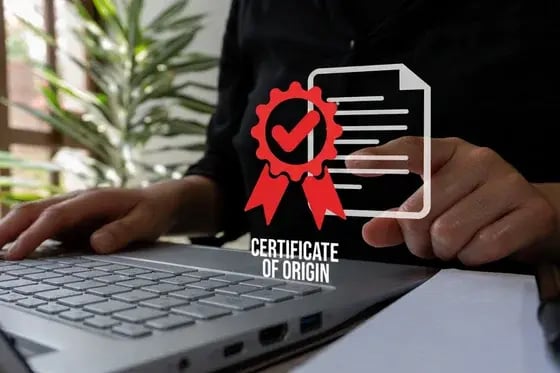 In international trade, documentation isn’t just paperwork—it’s what keeps your shipments moving. And few documents are as important as the certificate of origin (COO).
But if your team is still relying on paper-based processes, you may already be feeling the strain. Exporters today are facing increasing documentation requirements, tighter enforcement and growing pressure from global partners to go digital.
So the question isn’t just paper vs. electronic. It’s whether your export process is keeping up with the realities of modern trade.
What Is a Certificate of Origin and Why It Matters More Than Ever
A certificate of origin is a document that certifies the country where a product was manufactured. It’s used by customs authorities to determine duties, enforce trade agreements and verify compliance with regulations. In many cases, the certificate must be reviewed and certified by a chamber of commerce, which acts as an independent third party confirming that the exporter has provided supporting documentation for the origin claim.
In many ways, the COO acts as the “cover letter” of your shipment. That first impression matters. And today, the stakes are higher than ever:
- Customs authorities are increasing enforcement of origin declarations
- Importers are demanding more documentation from exporters
- Errors are more likely to be caught—and penalized

Why Certificates of Origin Are Becoming More Common
If it feels like you’re being asked for COOs more often than before, you’re not imagining it.
In our recent webinar, Determining the Country of Origin for Your Products, Alex Sonifrank of the American World Trade Chamber of Commerce (AWTCC) explained that exporters are seeing a surge in documentation requirements worldwide. (Watch the webinar recording at the link above.)
In fact, Sonifrank said many exporters are being caught off guard: “At least once a day… we’re getting companies reaching out and saying, ‘I’ve been shipping for the last 30 years—I’ve never needed a stamped certificate of origin before.’”
What’s driving more importers to request COOs?
- Increased Trade Enforcement: Governments are tightening controls around tariffs, sanctions and trade agreements.
- Supply Chain Transparency: Customs authorities now care not just about where a product is made but where its components originate.
- Rising Fraud Concerns: Importers are requiring more documentation, including chamber-certified eCOs, to verify legitimacy.
- Importer Requirements: Even when not legally required, many importers now request certificates to reduce their risk and support downstream compliance.
As Sonifrank put it: “Documentation requirements are absolutely increasing as time goes on… we don’t necessarily expect that trend to change.”
The Traditional Approach: Paper Certificates of Origin
For decades, exporters have relied on paper certificates of origin. The process typically looks like this:
- Complete a COO form manually or using a template
- Print the document
- Submit it to a chamber of commerce
- Obtain a physical stamp and signature
While familiar, this approach comes with significant drawbacks:
- Slow turnaround times
- Higher risk of errors and rework
- Shipment delays due to manual handling
- Limited visibility and tracking
- Increased risk of document fraud or alteration
In today’s fast-moving supply chains, these inefficiencies can quickly become costly.
The Global Shift to Electronic Certificates of Origin (eCOs)
Electronic certificates of origin (eCOs) allow exporters to create, submit and receive certified COOs entirely online—and globally, they’re quickly becoming the standard.
.webp?width=350&height=453&name=Sample%20eCO%20Electronic%20Certificate%20of%20Origin%20(1).webp) According to Sonifrank, China has moved to 100% electronic certificates of origin, while Europe is largely electronic and much of the Asia-Pacific region has made the same shift. However, gaps remain. As one UAE importer noted, “When we receive shipments from America, it is still difficult to clear goods at times due to the requirement for original documents—specifically because the certificate of origin is not provided digitally.”
According to Sonifrank, China has moved to 100% electronic certificates of origin, while Europe is largely electronic and much of the Asia-Pacific region has made the same shift. However, gaps remain. As one UAE importer noted, “When we receive shipments from America, it is still difficult to clear goods at times due to the requirement for original documents—specifically because the certificate of origin is not provided digitally.”
While many U.S. exporters still rely on paper, much of the world has already moved on.
The shift to eCOs isn’t just about convenience. It’s about compliance and security.
eCOs eliminate mailing delays and in-person visits. Documents can often be reviewed and certified the same day, and eCOs include features like:
- Unique certificate numbers
- QR codes
- Verification through chamber portals
And importantly, they’re more secure than traditional paper methods.

How to Create an eCO
Many importers now expect digital documentation—and some even question paper-based processes altogether.
Shipping Solutions has partnered with AWTCC to make creating an eCO accredited by the International Chamber of Commerce quick and affordable. Simply register for a free account on our eCO portal here. After receiving your login details, you’ll enter shipment details and upload supporting documents. Turn-around is typically hours rather than days and costs only $50 per document rather than a couple hundred dollars with signing and courier fees. (Shipping Solutions software maintenance subscribers save an additional $25 per document.)
This video walks you through the process:
Paper vs. Electronic Certificates of Origin
| Factor | Paper CO | Electronic CO (eCO) |
|---|---|---|
| Speed | Slow, manual processing | Fast, often same-day |
| Accuracy | Higher risk of errors | Built-in validation reduces mistakes |
| Security | Can be altered or lost | Secure, digitally verified |
| Compliance | Commonly used for FTA certificates and still accepted in many destinations, but requires manual checks and may not meet evolving global standards | Meets or exceeds compliance standards in most cases, with structured workflows that support global requirements |
| Convenience | Requires printing and physical handling | Fully digital workflow |
| Storage | Physical storage required | Secure digital recordkeeping |
| Cost | Higher indirect costs (courier fees, delays, admin time) | Lower overall cost with faster processing and fewer errors |
What about Free Trade Agreement (FTA) Certificates of Origin?
When you’re exporting under a free trade agreement (FTA)—like USMCA or U.S. agreements with Korea, Australia or Singapore—the goal isn’t just to identify origin. It’s to prove your product qualifies for reduced or zero tariffs.
In many of these cases, a formal, chamber-stamped COO may not be required and the certificate is often self-certified by the exporter. However, specific data elements and language are required depending on the agreement. To help exporters meet these requirements, Shipping Solutions offers a free library of certificate of origin templates for the FTAs the United States has with its trading partners.
Even though FTAs are often less formal, they’re not lower risk. Sonifrank said more and more exporters are choosing to digitize their FTA documentation processes simply to ensure consistency, accuracy and audit readiness across all shipments. It’s also becoming more common for importers to request an eCO certified by a chamber, even under an FTA.
Get Ahead of the Shift to Digital Trade
Global trade is moving in one direction: digital.
But certificates of origin are just one piece of the export documentation puzzle.
If you’re looking to streamline all of your export paperwork, Shipping Solutions export documentation and compliance software can help you:
- Reduce errors with built-in compliance checks
- Automate document creation for commercial invoices, packing lists and more
- Determine exactly which documents you need for each shipment
If you think we could help, we’d love to show you how it works!
Like what you read? Join thousands of exporters and importers and subscribe to the International Trade Blog to get the latest news and tips for exporters and importers delivered to your inbox.