The International Trade Blog  Export Compliance
Standard vs. Routed Export Transactions: What U.S. Exporters Need to Know
On: January 21, 2026 | By:  David Noah |
13 min. read
David Noah |
13 min. read
 Every so often, I get a call from an exporter who sounds a little uneasy.
They say something like, "Our customer says this is a routed shipment, so we don't have to worry about AES anymore... right?"
Then another call comes in. And an email. And then the same question regularly shows up in our export webinar Q&A sessions.
After a couple of decades talking with thousands of exporters about Electronic Export Information (EEI) filings to the Automated Export System (AES), I've learned this much:
Standard vs. routed export transactions are one of the most consistently misunderstood areas of U.S. export regulations. And the misunderstanding usually starts with who is responsible for what—especially when a freight forwarder is involved.
Let me explain the difference while trying to avoid unnecessary jargon.
What Is a Standard Export Transaction?
According to the U.S. Census Bureau's Foreign Trade Regulations, a standard export transaction is one in which the U.S. Principal Party in Interest (USPPI) controls the export of goods from the United States.
In practical terms, this usually means:
- The USPPI arranges the transportation
- The USPPI hires and works with the freight forwarder
- The USPPI is responsible for filing the EEI to AES on the Automated Customs Environment (ACE) Portal
Under the FTR, the EEI must generally be filed when the value of the goods exceeds $2,500 per Schedule B number, or when an export license is required, regardless of value.
This is the scenario most exporters are comfortable with—and the one most people have in mind when they first learn about AES.

What Is a Routed Export Transaction?
A routed export transaction is different, and this is where exporters can sometimes get confused.
In a routed export transaction:
- The Foreign Principal Party in Interest (FPPI), usually the foreign customer, purchases the goods
- The FPPI hires and authorizes a U.S. agent (often a freight forwarder) to arrange export transportation
- The FPPI also authorizes a party located in the U.S. to prepare and file the EEI
The FTR specifically recognizes this type of export transaction, but exporters aren't always aware of their responsibilities under this arrangement.
Who Files the EEI In a Routed Export Transaction?
Unless the FPPI is physically located in the United States and has an EIN or DUN number, they must provide written authorization to someone located in the United States to do the EEI filing.
Option 1: The FPPI Authorizes the USPPI to File the EEI
If the FPPI provides written authorization, the USPPI may prepare and file the EEI even though this is a routed export transaction.
For many exporters, this is often the cleanest option for ensuring compliance. The exporter retains visibility, control and confirmation that the filing was completed correctly.
This is also where many exporters use the Shipping Solutions export documentation software to file the EEI through AES without re-entering all the export data on the ACE portal, while simultaneously generating accurate commercial invoices, packing lists and other export forms.
Option 2: The FPPI Authorizes their Agent to File the EEI
This is the more common scenario and the one that creates more risk for U.S. exporters.
When the FPPI authorizes a freight forwarder or other agent to file the EEI:
- The agent must obtain a power of attorney or other written authorization from the FPPI
- The USPPI must still provide complete and accurate shipment data to that agent
This is where many exporters underestimate their ongoing responsibility.
Here's a simple side-by-side view of how responsibilities differ and where they don't:
Comparison of Standard and Routed Export Transactions
| Area of Responsibility | Standard Export Transaction | Routed Export Transaction |
|---|---|---|
| Who is the USPPI? | U.S. exporter | U.S. exporter |
| Who controls the shipment? | USPPI | FPPI (via authorized U.S. agent) |
| Who arranges freight? | USPPI or their agent | FPPI’s authorized U.S. agent |
| Who files EEI? | USPPI (or their authorized agent) | FPPI-authorized agent or USPPI if authorized |
| Is written authorization required? | Yes, if agent files for USPPI | Yes, from FPPI to USPPI or agent |
| Who provides export data? | USPPI | USPPI |
| Who is responsible for data accuracy? | USPPI | USPPI |
| Does Incoterms determine EEI responsibility? | No | No |
| Compliance risk for USPPI | Direct and obvious | Still significant, often underestimated |
| Best practice for exporters | File EEI directly | File EEI if authorized, or use a detailed SLI |
What Information Must the USPPI Still Provide?
Even when the USPPI does not file the EEI, the FTR requires the USPPI to supply accurate data to the authorized agent, including:
- Name and address of the USPPI
 Employer Identification Number (EIN) or other tax ID
- Point of origin of the merchandise
- Domestic (D) or Foreign (F) product indicator
- Schedule B number
- Schedule B description
- Quantity and unit of measure
- Value
- Export Control Classification Number (ECCN) or sufficient technical data to determine it
If any of this information is wrong, incomplete or misunderstood, the risk doesn't magically shift overseas.
That's why it's best practice to provide this information using a Shipper's Letter of Instruction (SLI) that follows the National Customs Brokers and Forwarders Association of America (NCBFAA) format.
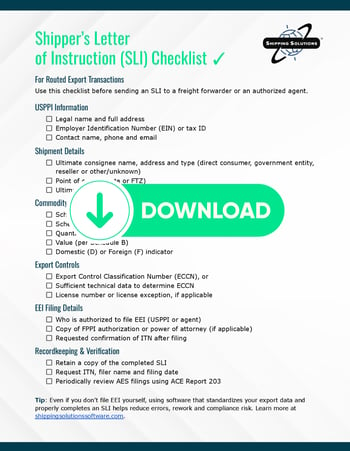
Many exporters use Shipping Solutions software to create this SLI in addition to their other export forms—even when they rely on a third party to file the EEI—because it allows them to generate an accurate, standardized SLI quickly and maintain a clear compliance record. If you're creating the form on your own, download this free checklist to make sure you're including all of the necessary information on your SLI.
"But the Forwarder Files It—Why Should I Worry?"
I hear this question a lot, and I understand where it comes from.
Here's the reality: Routed export transactions reduce control, not responsibility.
Your customer is usually outside the U.S. They may not understand U.S. export regulations. They may not prioritize them. And in some cases, they may actively prefer not to think about them.
You don't have that option.
Even when EEI filing authority is delegated, U.S. exporters remain responsible for:
- The accuracy of the data they provide
- Compliance with export control regulations
- Responding to inquiries or audits tied to their EIN
This is why I often recommend negotiating the right to file the EEI yourself in routed transactions whenever possible. I've written about that in my article, Why I Hate Routed Export Transactions. The core issue is simple: Compliance works best when exporters maintain visibility into the process.

How to Protect Yourself If You Don't File the EEI
Whether it's a standard or a routed export transaction, if you are unable or unwilling to submit the EEI filing yourself, take these steps at minimum to protect your company:
- Request the Internal Transaction Number (ITN) issued by AES
- Confirm the name of the filer and the filing date
- Run ACE Report 203 to review AES filings associated with your EIN
- Retain copies of SLIs and related documentation
These steps don't eliminate risk—but they significantly reduce blind spots.
A Note about Incoterms and Routed Export Transactions
This is where many exporters get tripped up.
Incoterms 2020 Rules—including EXW—are not recognized in the Foreign Trade Regulations. They do not determine roles and responsibilities in an export transaction, including who files the EEI.
Yes, EXW is commonly associated with routed export transactions. The association has become almost automatic in some organizations. But it's a shortcut—not a regulatory rule.
Incoterms define:
- Cost allocation
- Risk transfer
- Delivery obligations
They do not assign EEI filing responsibility under U.S. law.
That's why two shipments using the same Incoterm 2020 Rule can have different EEI filing obligations, depending on how authority is granted and documented. Understanding this distinction helps exporters avoid costly assumptions, especially when exporters insist that EXW means their responsibilities for an export transaction ends as soon as the goods leave their warehouse.
Final Thoughts
Standard and routed export transactions aren't just theoretical classifications. They affect:
- Who controls the export process
- Who files the EEI
- How compliance risk is managed
Whether you file the EEI yourself or rely on a third party, having accurate data, clear documentation and visibility into the process is critical. That's exactly where export documentation software—particularly tools that support both AES filing and SLI creation—play an important role for exporters. If you'd like to see how this works in practice—whether you file the EEI yourself or rely on a forwarder—I'm happy to show you. There's no obligation.
If you've ever felt unsure about where your responsibility ends in a routed transaction, you're not alone. Most exporters I talk with have asked the same questions, often after something didn't go quite right.
Like what you read? Subscribe today to the International Trade Blog to get the latest news and tips for exporters and importers delivered to your inbox.
This article was first published in July 2017 and has been updated to include current information, links and formatting.