The International Trade Blog  Export Compliance
Export Classification Explained: ECCN vs. HS, HTS and Schedule B
On: February 9, 2026 | By:  David Noah |
14 min. read
David Noah |
14 min. read
 If you export products from the United States, product classification isn’t optional. It’s a core part of export compliance, and it’s also one of the areas where exporters—especially those newer to international trade—are most likely to get tripped up.
Over the years, I’ve spoken with many exporters who are unsure whether they should be using an Export Control Classification Number (ECCN), an HS code, an HTS code, a Schedule B number or all of them. The confusion is understandable. These classification systems sound similar, they all involve numbers and they often appear on the same export paperwork.
The problem is that they serve very different purposes.
In this article, I explain the differences between these classification systems so you can better understand how your products should be classified, why it matters and what steps you should take to stay compliant with U.S. export and import regulations.
Why Product Classification Matters in Exporting
Product classification affects far more than paperwork. It determines whether your product requires an export license, how it must be reported to the U.S. government and how it may be taxed as it moves across borders.
Using the wrong classification can lead to shipment delays, rejected filings, audits or penalties—often without any intent to violate the rules. Many exporters run into problems simply because they assume one classification system covers everything.
In reality, exporters usually need two different types of classifications:
- One for export control purposes. (Does my product require an export license?)
- One for customs and statistical purposes. (What value, quantity and unit of measure must be reported when I file the EEI?)
Understanding the difference between these two systems is a key step toward building a reliable export compliance process.

Two Classification Systems, Two Very Different Purposes
At a high level, product classification answers two separate questions.
Export control classification asks:
Can I export this product, and do I need a license?
Customs classification asks:
How is this product identified, tracked and taxed by customs authorities?
Export control classification usually relies on ECCNs under U.S. export regulations. Customs classification relies on HS, HTS and Schedule B codes.
The systems are related, but they are not interchangeable. Confusing them can lead to real compliance issues.
Customs Classification: HS, HTS and Schedule B Codes Explained
Customs classification is based on the Harmonized System (HS), an international product classification framework used by customs authorities in most countries around the world. The HS itself does not assign duty rates. Individual countries apply duties through their own national tariff schedules, such as the U.S. Harmonized Tariff Schedule.
HS codes consist of six digits and provide a common global foundation for identifying products. When exporters communicate product classifications with overseas customers, suppliers or foreign customs authorities, they typically reference the HS code.
Most countries, including the United States, add additional digits to the HS code for national purposes.
In the United States, imports are classified using the Harmonized Tariff Schedule of the United States (HTSUS). HTS codes are 10 digits long. The first six digits match the HS code, while the remaining digits are specific to the U.S. tariff system and determine duty rates and statistical tracking for imports.
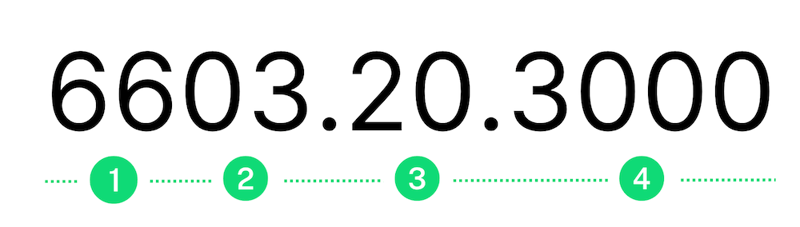 Global and U.S. HTS Codes have four components, which are identified by the green numerals beneath the digits:
- Chapter: In this example, 66 is the chapter.
- Heading: In this example, 6603 is the heading. The heading dictates the specific category within any particular chapter.
- Subheading: 6603.20 is the subheading. The last 2 digits of the international Harmonized Code are more specific, defining subcategories of products.
- Extra digits: 6603.20.3000 is the suffix (or extra digits). Countries can use an additional 2-4 digits for country-specific categorizations. For example, the United States relies on 10-digit codes (the HTSUS numbers).
For exports, the United States uses Schedule B codes, which are also 10 digits long. Schedule B codes are used primarily for export statistics and for filing Electronic Export Information (EEI) through the Automated Export System (AES).
Schedule B codes are based on the same HS framework and often align closely with HTS codes, but they are not always identical. Exporters should not assume that an HTS code used for imports is automatically correct for export reporting.
In practice, U.S. exporters typically use:
- Schedule B codes for EEI/AES filings
- HS codes when communicating with international partners

Export Control Classification and Jurisdiction
Export control classification is a separate process governed by U.S. export regulations.
Several U.S. government agencies regulate exports, depending on the nature of the product. Most commercial and dual-use items fall under the Export Administration Regulations (EAR), administered by the Department of Commerce through the Bureau of Industry and Security (BIS).
Certain military, defense or space-related items may instead fall under the jurisdiction of the Department of State’s Directorate of Defense Trade Controls (DDTC) and the International Traffic in Arms Regulations (ITAR).
Before assigning an ECCN, exporters must first determine which agency has jurisdiction over their product. This article focuses on products subject to the EAR, which applies to the vast majority of commercial exports.
What Is an Export Control Classification Number (ECCN)?
An Export Control Classification Number is used for export control purposes, not customs duties.
ECCNs appear on the Commerce Control List (CCL), which is administered by BIS. BIS oversees export controls for dual-use items—commodities, software and technology that may have both civilian and military or proliferation applications.
An ECCN is a five-character alphanumeric designation, such as 3A001 or 5D992. It identifies:
- the type of item
- the reason the item is controlled
- the circumstances under which an export license may be required
The ECCN plays a central role in determining whether you need an export license based on the destination, end user and end use of your product.

How the Commerce Control List Is Organized
The Commerce Control List is structured to help exporters narrow down products systematically.
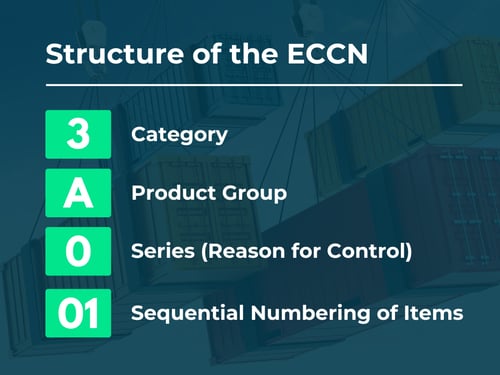 It is divided into:
- 10 broad categories, numbered 0 through 9
- Five product groups within each category, identified by a letter:
- A: Systems, equipment and components
- B: Test, inspection and production equipment
- C: Materials
- D: Software
- E: Technology
The first two characters of an ECCN identify the category and product group. From there, exporters must compare the technical characteristics of their product to the detailed descriptions within the ECCN entry.
Not every product will match an ECCN on the CCL. However, exporters are expected to perform a reasonable review before concluding that no ECCN applies.
How to Determine the Correct ECCN for Your Product
There are three common ways exporters determine ECCNs.
1. Self-classification
Many exporters classify their own products by reviewing the CCL and comparing technical specifications. This requires a solid understanding of the product and careful reading of ECCN descriptions. Shipping Solutions Product Classification Software makes this process easier.
2. Requesting an official classification (CCATS)
Exporters may submit a commodity classification request through the government’s SNAP-R system to receive an official determination from BIS. This option is often used when classifications are unclear or high risk.
3. Relying on vendor information
Exporters may also ask the manufacturer or developer of an item to provide the ECCN. While this can be helpful, the exporter remains responsible for confirming that the classification is accurate and current.
Regardless of the method used, exporters should document how the ECCN was determined and ensure that the process aligns with and is supported by the company’s written Export Compliance Program.
What If You Can’t Find an ECCN? Understanding EAR99
Unlike HS codes, where every product has a classification, not all items appear on the Commerce Control List. If a careful review confirms that no ECCN applies, the item is classified as EAR99.
EAR99 does not mean that no rules apply. It simply means the item is not listed under a specific ECCN.
Most EAR99 items may be exported under NLR (No License Required), provided:
- the destination is not sanctioned
- the end user is not restricted
- the end use is not prohibited
End-use and end-user controls still apply to EAR99 items, and licenses may still be required in certain situations.
Important: Classification Codes Change—Stay Current
Product classifications are not static.
Both HTS and Schedule B codes are updated regularly in the United States, usually with the biggest update of the year occurring on or about January 1. For 2026, exporters should make sure they are using the updated list of Schedule B codes that became effective on January 1, 2026. Importers, on the other hand, should make sure they are using the updated list of HTS codes beginning February 1, 2026. (The International Trade Commission announced this delay in the effective date for the updated U.S. HTS codes due to the government shutdown.)
Both exporters and importers should plan for larger and more widespread changes in 2028 when the World Customs Organization (WCO) updates the global Harmonized System. These updates generally happen on a five-year cycle, but this time because of COVID, we have to wait six years. The most recent version, HS 2022, took effect in 2022. The next major update, HS 2028, is expected to enter into force in January 2028.
As a best practice, exporters should review product classifications at least annually or sooner when launching new products, entering new markets or responding to regulatory updates.
Final Thoughts and Next Steps
Every export product needs a customs classification. Not every product has an ECCN. Both classifications matter, and each serves a different compliance purpose.
Understanding how export control classification differs from customs classification helps exporters avoid costly mistakes, reduce delays and build more dependable export processes.
When in doubt, verify your classifications, document your decisions and stay informed about regulatory changes. A small investment of time up front can prevent much bigger problems later.
Shipping Solutions Product Classification Software can help exporters more easily determine both export control and customs classifications and maintain consistency over time. You can see how it works by requesting a free trial. There is no obligation.
Like what you read? Subscribe today to the International Trade Blog to get the latest news and tips for exporters and importers delivered to your inbox.
This post was originally published in July 2018 and has been updated to include current information, links and formatting.