The International Trade Blog  International Sales & Marketing
Exporting to Brazil: What You Need to Know
On: June 24, 2026 | By:  David Noah |
16 min. read
David Noah |
16 min. read
Editor’s Note (June 2026): This article has been updated to reflect recent tariff developments and current trade policy considerations for U.S. exporters exporting to Brazil.
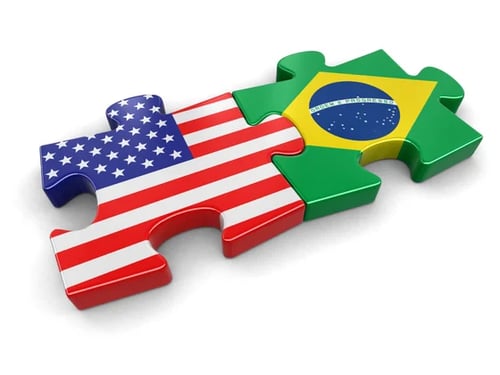
Despite complex domestic regulatory and tax frameworks that often present challenges to exporters, Brazil remains one of the largest and fastest-growing markets in Latin America, offering significant opportunities for U.S. exporters. Its diverse economy, large population, and growing demand for industrial, technological, and consumer goods make it an attractive destination for American companies.
However, Brazil has complex import regulations, tariffs, and documentation requirements. Understanding these rules is critical to ensure smooth shipping, avoid fines, and maximize profitability.
In this article, I’ll look at the history of U.S. trade with Brazil; the process of exporting to Brazil, including documentation and compliance requirements; and the benefits and considerations for U.S. companies looking to break into the Brazilian market,

Trade and Exporting to Brazil
The early 2020s in Brazil saw periods of economic volatility, including slower growth and political challenges, which affected domestic industries and commercial confidence. Despite these headwinds, Brazil remains a significant and growing market for U.S. exporters. According to the U.S. Census Bureau, total U.S. exports of goods to Brazil in 2025 were approximately $54.4 billion, while imports from Brazil totaled about $39.9 billion, resulting in a goods trade surplus of roughly $14.4 billion for the United States.
The United States continues to be among Brazil’s most important trading partners, with strong demand for American industrial equipment, technology, machinery, and consumer goods. This robust commercial relationship underscores Brazil’s role as a key market for U.S. exports in the Western Hemisphere, even as broader geopolitical and trade policy developments evolve.
Trade Policy Updates (2025–2026)
While Brazil does not have a free trade agreement with the United States, U.S. exporters should be aware of recent developments:
- In 2025, the U.S. imposed tariffs on certain Brazilian imports, particularly steel and aluminum. While these tariffs do not directly affect U.S. goods sent to Brazil, they have influenced trade patterns and logistics costs.
- Brazil introduced the Brasil Soberano Plan, offering support to exporters affected by U.S. tariffs, including credit lines and tax deferrals.
- U.S. exporters should monitor ongoing tariff negotiations and any new trade measures that could indirectly affect their business.
U.S. companies can continue exporting to Brazil without new U.S. tariffs, but monitoring trade policy developments is important. Indirect effects exporters should consider include the following:
- Supply chain disruptions: tariffs can increase costs or limit the availability of inputs.
- Global trade tensions may affect Brazilian buyers’ purchasing and affect demand.
- Future trade measures: Certain products may face new restrictions.
Exporting to Brazil: The Challenges
The high direct and indirect costs of doing business in Brazil is commonly referred to in Portuguese as the “Custo Brasil” or “Brazilian Cost,” and it is a challenge for any exporter looking to enter the market. The World Bank’s Business Ready report ranks Brazil 124 out of 190 countries in terms of ease of doing business, falling from number 109 in 2019 despite numerous positive economic reforms.
U.S. exporters must be aware of certain barriers when exporting to Brazil. But with careful planning and assistance from agencies like the U.S. Commercial Service, exporters of all sizes can absolutely be successful in the Brazilian market. According to the Brazil Country Commercial Guide, challenges include:
Unpredictable Economic Recovery
Economic growth has largely stagnated or trended downward annually since 2012. Amplified by the pandemic’s economic toll, this trend has driven down domestic demand and caused Brazil’s currency, the real, to weaken significantly, lowering Brazilian buying power for U.S.-made products. Despite the current government making some progress in economic reform, much of the agenda remains incomplete.
Complicated Tax System
Without a free trade agreement, Brazil imposes high taxes and tariffs on imported goods and services coming from the U.S. and other markets. Brazil applies federal and state taxes and charges to imports that can effectively double the cost of imported products in Brazil.
In addition to high taxes, the system is incredibly complex, and in 2020, it ranked 184 out of 190 countries in terms of ease of paying taxes according to the World Bank’s Business Ready report. The complexities of Brazil’s domestic tax system, including multiple cascading taxes and tax disputes among the various states, pose numerous challenges for all companies operating in and exporting to Brazil, even the most experienced ones.
New U.S. exporters should seek special guidance to understand how the tax system affects specific industries and products. The U.S. Commercial Service has numerous industry specialists and a host of other contacts that are equipped with tools to help U.S. exporters succeed when met with the bewildering bureaucracy surrounding taxes and tariffs.
Non-tariff Barriers
In addition to a complicated tax and tariff system, exporters can expect to encounter a complicated regulatory system, lack of adequate or effective intellectual property protection and enforcement, and Brazil-unique standards with often little to no recognition of the international standards commonly used in the United States. Companies need to navigate a complex web of federal, state, and local regulations affecting their products and must also be prepared to meet different standards and technical requirements from those used in the United States to sell their products in Brazil. Even if a company has already tested its products and successfully met technical requirements in the United States, it may still be necessary to re-test and re-certify those products to meet the technical requirements used in Brazil.
Logistical Costs and Delays
Poorly developed infrastructure and inefficient customs processes mean that getting products to a destination can often be a lengthier process than many exporters are accustomed to experiencing. Companies should be prepared to face high costs and delays in getting goods into the market due to a complicated tax system, bureaucratic customs procedures, and inadequate infrastructure. However, Brazil has been committed to improving its infrastructure and bureaucratic inefficiencies over the past several years; as a result, clearance overhead time and costs are falling.
Exporting to Brazil: The Opportunities
In some situations, the potential rewards of exporting to Brazil outweigh any challenges exporters may face. Exporters should identify and cultivate business opportunities while building a strategy to minimize the risks.
Brazil has made tangible progress in developing a friendlier business environment, and U.S. companies continue to have success in the country. The following are sectors with high export potential:
- Civil aviation
- Healthcare
- Digital economy
- Oil and gas
- Renewable energy
- Safety and security
- Critical and emerging technologies
However, given the sheer size and diversity of the Brazilian market, there is potential for export success in practically any industry. U.S. exporters are encouraged to familiarize themselves with the Brazilian market and take advantage of trade promotion services and programs available through the U.S. Commercial Service.
Export Assistance
The best thing about exploring the opportunities to export to Brazil is knowing you don’t need to go it alone. You can rely on assistance from your in-country allies, including the U.S. Commercial Service office, trade missions, and chambers of commerce.
U.S. Commercial Service Offices
One of the first places to consider are your local and in-country U.S. Commercial Service offices. The Commercial Service in-country offices offer U.S. exporters business partners in Brazil—boots on the ground in the country—and include representation by an agent, distributors or partners who can provide essential local knowledge and contacts that can be critical for your success. You can learn more about in-country offices in our article, Tapping into the U.S. Commercial Service's In-Country Offices.
District Export Councils (DECs)
DECs across the country can help exporters by supporting trade and services that strengthen individual companies, stimulate U.S. economic growth, and create jobs. DEC members also serve as mentors to new exporters and can provide advice to smaller companies.
Sponsored by state and local trade offices as well as commercial service offices, trade missions are a great way to get introduced to and network with contacts. Check into them.
International Trade Administration (ITA)
The ITA is an excellent resource to help you combat trade problems. ITA staff are resident experts in advocating for U.S. businesses of all sizes. They customize their services to help solve your trade dilemmas as efficiently as possible. The ITA makes it easy to report a problem, allowing you to submit your report online.
Chambers of Commerce
Chambers of commerce may be a resource when exporting to Brazil. You can learn more about various chambers and how they can help smooth the way for your export activities in our article, The Chamber of Commerce Role in Exporting.
Export Document Requirements for Brazil
Export documentation and procedures for Brazil are as critical as they are for any other country. Though there is no free trade agreement with Brazil, documents you need to export to Brazil from the U.S. may include:
- Bill of lading
- Commercial invoice
- Packing list
- Sales contract
- Proforma invoice
- AES filing
- Customs declaration
- Insurance policy
You should also study up on Brazilian trade agreements and documentation requirements.

Export Compliance Issues When Exporting to Brazil
It’s important to understand the regulations covering exports to Brazil, especially export controls.
Product Classification for Export Controls
The first step in ensuring export compliance is determining who has jurisdiction over your goods: the U.S. Department of Commerce under the Export Administration Regulations (EAR) or the State Department's International Traffic in Arms Regulations (ITAR).
If your goods fall under the jurisdiction of the Commerce Department, which most products do, you must determine if your export requires authorization from the Bureau of Industry and Security (BIS, part of the Commerce Department). To do so you need to answer the following questions:
- What is the Export Control Classification Number (ECCN) of the item?
- Where is it going?
- Who is the end user?
- What is the end use?
There are three ways to classify your products for export controls: You can self-classify your products, submit a SNAP-R request for a ruling, or rely on the product vendor to provide the information. If you’re self-classifying, Shipping Solutions Product Classification Software makes the process easier than manually searching through codes and regulations. You can give it a try for free here.
By classifying your product correctly, you’ll be protecting yourself from potential fines, penalties and even jail time.
Export License Determination
Next, companies must use the ECCN codes and reasons for control described above to determine whether or not there are any restrictions for exporting their products to specific countries. Once they know why their products are controlled, exporters should refer to the Commerce Country Chart in the EAR to determine if a license is required.

Although a relatively small percentage of all U.S. exports and reexports require a BIS license, virtually all exports and many reexports to embargoed destinations and countries designated as supporting terrorist activities require a license. Countries fitting that bill are Cuba, Iran, North Korea and Syria. Part 746 of the EAR describes embargoed destinations and refers to certain additional controls imposed by the Office of Foreign Assets Control (OFAC) of the Treasury Department.
The Shipping Solutions Professional export documentation and compliance software includes an Export Compliance Module that uses the ECCN code for your product(s) and the destination country to tell you if an export license is required. If indicated, you must apply to BIS for an export license through the online Simplified Network Application Process Redesign (SNAP-R) before you can export your products.
There are export license exceptions, like low-value or temporary exports, that allow you to export or reexport, under stated conditions, items subject to the Export Administration Regulations (EAR) that would otherwise require a license. These license exceptions cover items that fall under the jurisdiction of the Department of Commerce, not items controlled by the State Department or some other agency.
Deemed Exports
Surprise! You may be an exporter without even knowing it! Deemed exports, or the disclosure of information or services rather than an actual product, is an important issue to pay attention to when exporting. A deemed export occurs when technology or source code (except encryption and object source code, which is separately addressed in the EAR under 734.2(b)(9)), is released to a foreign national within the United States.
Sharing technology, reviewing blueprints, conducting tours of facilities, and other information disclosures are considered potential exports under the deemed export rule and should be handled accordingly. You can learn how to apply this principle here.
Restricted Party Screenings
Restricted party lists (also called denied party lists) are lists of organizations, companies or individuals that various U.S. agencies—and other foreign governments—have identified as parties that one can’t do business with.
There are several reasons why a person or company may be added to a restricted party list. For example, they may be a terrorist organization or affiliated with such an organization, they may have a history of corrupt business practices, or they may otherwise pose a threat to national security.
Restricted party screening (or denied party screening) refers to the process in which a company checks a potential customer or business partner against one or more of the restricted party lists to ensure they are not doing business with a restricted party.
The primary restricted party lists in the United States are published by the Department of Commerce, Department of State, and Department of Treasury. However, several other agencies produce lists as well. These agencies recommend that companies perform
restricted party screening periodically and repeatedly throughout the movement of goods in the supply chain.
When exporting to Brazil, it’s imperative you check every single restricted party list every time you export.
- Fines for export violations can reach up to $1 million per violation in criminal cases (Bureau of Industry and Security).
- Administrative cases can result in a penalty amounting to $250,000 or twice the value of the transaction, whichever is greater.
- Criminal violators may be sentenced to prison for up to 20 years, and administrative penalties may include denial of export privileges.
Shipping Solutions Restricted Party Screening Software makes it fast and easy to check hundreds of lists at once, and it provides detailed information about potential matches, so you can make an informed decision about what to do next. Give it a try for free.
Exporting To Brazil: Final Thoughts
Exporting to Brazil presents both opportunities and challenges. By understanding regulations, documentation requirements, logistics, and compliance rules, U.S. exporters can successfully expand into Brazil’s growing market. Careful planning and collaboration with experienced partners are essential to avoid delays, control costs, and maximize profitability.
Shipping to the Brazil, the EU, Canada or other global markets involves more than simply moving products from point A to point B. Exporters must navigate complex regulations, documentation requirements and tax systems—often with little margin for error.
That’s where Shipping Solutions can help.
With Shipping Solutions export documentation and compliance software, exporters can quickly create accurate export documents, run restricted party screenings against hundreds of lists at once, and reduce the risk of costly compliance mistakes.
For companies that want additional support, GLOBAL GATEWAY by Shipping Solutions brings everything together in one place. This all-in-one export management service combines expert compliance support, integrated export documentation and discounted international shipping in a single streamlined solution.
Whether you’re just beginning to export or already shipping worldwide, Global Gateway works like an extension of your logistics team—without the added overhead.
You don’t need to master every detail of international trade to succeed globally. You just need the right partner.
Schedule a free, no-obligation consultation to learn how we can support your exports.
This is one in a series of articles exploring exporting to specific countries across the globe—we previously featured ASEAN countries, Australia, Belgium, Brazil, China, the EU, France, Germany, India, Israel, Japan, Mexico, the Netherlands, Russia, Singapore, South Korea, Taiwan and the United Kingdom.
Like what you read? Subscribe today to the International Trade Blog to get the latest news and tips for exporters and importers delivered to your inbox.