The International Trade Blog  Export Compliance
What Exporters Need to Know About 2025 Changes to the U.S. Foreign Trade Regulations
On: January 14, 2026 | By:  Kari Crane |
18 min. read
Kari Crane |
18 min. read
 In August 2025, the U.S. Census Bureau published a final rule amending the Foreign Trade Regulations (FTR), marking the most significant update in years. The new rules became effective September 15, 2025, and include major clarifications to definitions, filing responsibilities and data requirements that exporters follow when filing Electronic Export Information (EEI) through the Automated Export System (AES).
To help exporters prepare, Shipping Solutions hosted a free webinar with officials from the Trade Regulations Branch (TRB) of the U.S. Census Bureau. Below we recap the highlights, or you can watch the full recording here:
A Review of Changes to the U.S. Foreign Trade Regulations
Updated Definitions You Need to Know
The rule clarifies and revises several key terms used in the FTR. Here are some of the notable changes:
Intermediate Consignee
The term was revised to emphasize physical possession, ensuring only those entities directly handling the goods qualify. Learn more in our article, Who Is the Intermediate Consignee?
Conveyance (New Addition)
This is now officially defined as the aircraft, vessel, railcar, truck or other means of transport used to move goods internationally. This helps standardize terminology used throughout the FTR.
Consignee (Removed)
The standalone definition for “consignee” was deleted because it was redundant. Only ultimate and intermediate consignees are defined moving forward.
Incoterms Are Not Recognized in the FTR
While this has long been an unofficial stance, the FTR now clearly states that Incoterms are not recognized in the FTR and have no bearing on how you determine roles or responsibilities in an export transaction.

Clarified USPPI Scenarios (With Decision Tree!)
For EEI filing purposes, the U.S. Principal Party in Interest (USPPI)—or the authorized agent filing on the USPPI’s behalf—must be physically located in the United States at the time the EEI is filed.
The Census Bureau clarified that a foreign entity physically present in the U.S. at the time the goods are purchased or obtained for export can be listed as the USPPI. However, foreign entities are prohibited from filing the EEI themselves and must authorize a U.S.-based agent to file on their behalf. This applies across all types of export scenarios.
Reexports of Previously Imported Goods
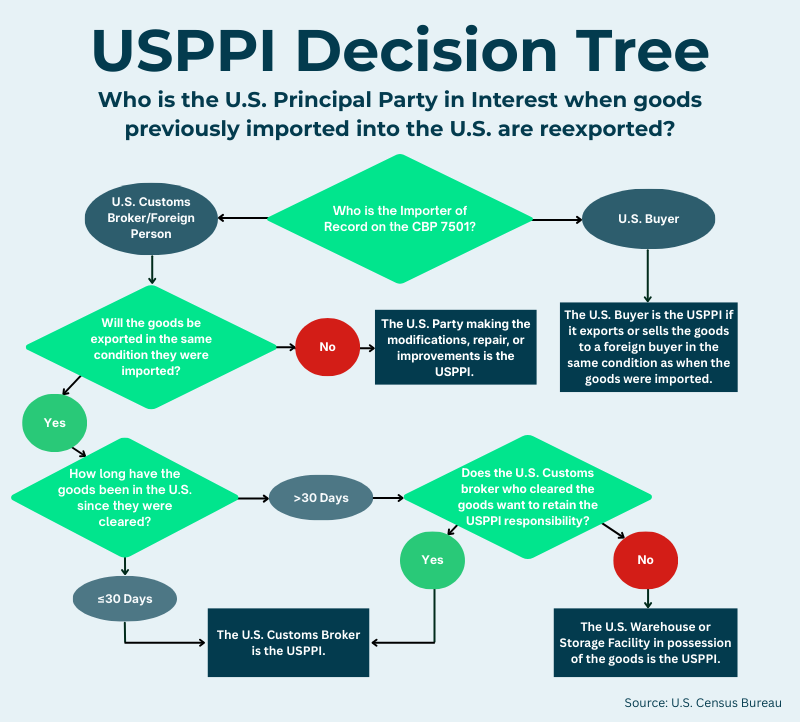
During the webinar, Census introduced a decision tree to help determine who should be listed as the USPPI on reexports of goods that were previously imported into the United States, based on factors like:
- Who was listed as the importer of record on the CBP Form 7501
- Whether the goods are being exported without modification
- How long the goods have been in the U.S.
- Whether the customs broker agrees to retain USPPI responsibility
The FTR also now includes guidance for Foreign Trade Zone (FTZ) scenarios related to the USPPI:
- If a U.S. person admits goods into the FTZ and later exports them without change, they are the USPPI.
- If a foreign person admits goods, the FTZ operator (defined in 19 CFR 146.1) is the USPPI in the EEI if the goods are then exported without change or enhancement.
AES Downtime Policy Now in One Section
A new section, 15 CFR §30.4(f), consolidates AES Downtime Policy procedures into one place, eliminating the need to search multiple references across the FTR.
Important reminders:
- If AES is down, certain shipments cannot proceed until the system is back online and an Internal Transaction Number (ITN) is received. This includes:
- Licensed shipments
- Self-propelled vehicles
- Only shipments that do not require predeparture filing can proceed during a downtime event, and must be filed as soon as AES is back up.

‘Address of Origin’ Replaces ‘Address of USPPI’
The data element formerly labeled “Address of the USPPI” is now clearly identified as “Address of Origin.”
This reflects what the field has always required: the U.S. location where the goods begin their journey to the port of export. This change is already live in AES, so make sure your templates and records reflect this new terminology. (Download free export forms in our library of templates.)
Ultimate Consignee Scenarios
In addition, the revised regulations add a couple scenarios defining who is the ultimate consignee:
- The end user is the ultimate consignee when there is knowledge of an end user’s name, address and when the end user will receive the goods.
- The foreign buyer is the ultimate consignee when the foreign buyer is a reseller/distributor and the end user’s name and address is unknown or there is no knowledge when the end user will receive the goods from the foreign buyer, e.g., the goods are stored in inventory.
EEI Confidentiality Rules Reinforced
You may not share EEI data with foreign persons or foreign companies, even when the foreign entity is the USPPI.
The FTR also clarified that voluntary self-disclosures must come from a U.S. person or company, not an FPPI or their legal counsel or another party representing an FPPI.
Appendix C Defines Responsibilities in Routed Transactions
A new Appendix C lists which EEI data elements the USPPI and the authorized agent are responsible for in a routed export transaction.
This addresses long-standing confusion about which party is responsible for which pieces of information and helps improve data accuracy. Learn more in our article, Standard vs. Routed Export Transactions: What U.S. Exporters Need to Know.
Party Responsibilities for Data Elements in Routed Export Transactions
| Responsibility of the USPPI 30.3(e)(1) |
Responsibility of the Authorized Agent 30.3(e)(2) |
|---|---|
| (A) Name, address of origin, contact name and contact phone of the USPPI | (A) Date of export |
| (B) USPPI identification number | (B) Ultimate consignee |
| (C) U.S. State of origin | (C) Ultimate consignee type |
| (D) Domestic or foreign indicator | (D) Country of ultimate destination |
| (E) Commodity classification number | (E) Method of transportation |
| (F) Commodity description | (F) Conveyance name/carrier name |
| (G) Primary unit of measure | (G) Carrier identification |
| (H) Primary quantity | (H) Port of export |
| (I) Value | (I) Related party indicator |
| (J) Export information code | (J) Shipping weight |
| (K) Hazardous material indicator | (K) Shipment Reference Number |
| (L) Inbond code | (L) License code/license exemption code |
| (M) License code/license exemption code | (M) Routed export transaction indicator |
| (N) FTZ identifier, if applicable | (N) Filing option indicator |
| (O) Export license number/CFR citation/KPC number, if applicable | (O) Authorized agent and authorized agent identification |
| (P) Export Control Classification Number (ECCN), if applicable | (P) Intermediate consignee, if applicable |
| (Q) Secondary units of measure, if applicable | (Q) Foreign port of unlading, if applicable |
| (R) Secondary quantity, if applicable | (R) Export license number/CFR citation/KPC number, if applicable |
| (S) Vehicle Identification Number (VIN)/Product ID, if applicable | (S) Transportation Reference Number, if applicable |
| (T) Vehicle ID qualifier, if applicable | (T) License value, if applicable |
| (U) Vehicle title number, if applicable | |
| (V) Vehicle title state code, if applicable | |
| (W) Entry number, if applicable | |
| (X) License value, if applicable |
Shipping Solutions Makes AES Filing Easy
These changes highlight how complex and dynamic export compliance can be. And that you don’t want to leave AES filing to chance. Shipping Solutions export documentation and compliance software makes AES filing easy:
- No redundant data entry—your EEI pulls directly from your shipment details
- Prompts ensure you include all required fields before submission
- Reduce errors and stay compliant with FTR regulations
- Avoid costly penalties and delays due to incomplete filings
- Save money—don’t pay your forwarder $50–$125 per filing!
We’d love to show you how it works!
And be sure to watch the full webinar recording to learn more about all the changes discussed above.
Like what you read? Join thousands of exporters and importers and subscribe to the International Trade Blog to get the latest news and tips delivered to your inbox.