The International Trade Blog  Export Compliance
What Is a Destination Control Statement and Why Should It Be on Your Commercial Invoice?
On: March 2, 2026 | By:  David Noah |
16 min. read
David Noah |
16 min. read

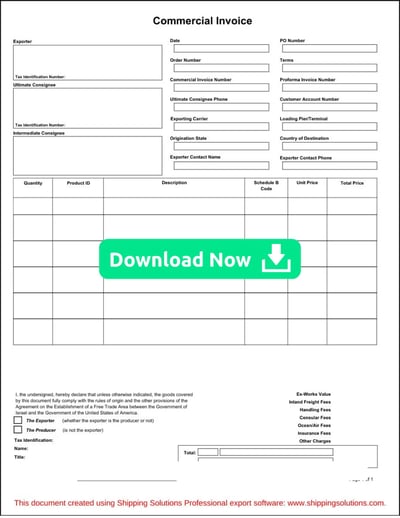
If you export controlled goods from the United States, the Destination Control Statement (DCS) is not optional. It’s a legal requirement under U.S. export regulations.
The DCS is a mandatory statement placed on your commercial invoice confirming that exported items are authorized only for the country and end user listed in your documentation. It helps prevent unauthorized diversion of controlled goods to prohibited destinations or parties.
Failure to include a required DCS can result in significant civil and criminal penalties. Let’s break down what exporters need to know in 2026.
What Is the Destination Control Statement?
The Destination Control Statement is required under:
- The Export Administration Regulations (EAR), administered by the Bureau of Industry and Security (BIS)
- The International Traffic in Arms Regulations (ITAR), administered by the U.S. Directorate of Defense Trade Control (DDTC)
The statement confirms that:
- The goods are authorized for export only to the stated country of ultimate destination
- The items may not be resold, transferred, or reexported to another country or party without U.S. government approval
In short: it legally reinforces that your shipment cannot be diverted.
When Is a Destination Control Statement Required?
According to BIS, all exported items listed on the Commerce Control List that are not classified as EAR99 or are eligible for license exception BAG or GFT require a Destination Control Statement. Exceptions to the DCS are listed in Part 758.6 of the EAR, and you can contact the U.S. Department of Commerce, an attorney or your freight forwarder to learn more.

While it’s not a requirement for all transactions, including a Destination Control Statement on every transaction is a good precaution to protect yourself in the event that merchandise you sold to a domestic purchaser is unexpectedly exported from the United States.
Official Destination Control Statement Wording
Since 2016, BIS and DDTC have accepted a single harmonized DCS for both EAR and ITAR-controlled items.
The Destination Control Statement must include the following statements at an absolute minimum:
These items are controlled by the U.S. Government and authorized for export only to the country of ultimate destination for use by the ultimate consignee or end-user(s) herein identified. They may not be resold, transferred, or otherwise disposed of, to any other country or to any person other than the authorized ultimate consignee or end-user(s), either in their original form or after being incorporated into other items, without first obtaining approval from the U.S. government or as otherwise authorized by U.S. law and regulations.
As of 2026, this harmonized language remains in effect.
Why the DCS Matters: A Real-World Risk Scenario
Imagine you’re exporting controlled goods to the United Arab Emirates. From there, without your knowledge, the goods are forwarded to Iran (a sanctioned destination under U.S. law). There are no restrictions between the UAE and Iran, and the Iranian company has a division in the UAE. In this case, you are breaking the law (whether you mean to or not).
It’s up to you to do your due diligence so a situation like this doesn’t occur. If a buyer is telling you they won’t transfer, but you have reason to believe the goods will get forwarded, you have to act accordingly.
Even if the diversion happened after delivery, U.S. authorities will evaluate:
- Whether you exercised due diligence
- Whether red flags were ignored
- Whether proper documentation (including a DCS) was used
Export enforcement agencies expect exporters to “know their customer” and identify diversion risks.
What Happens If You Don’t Include a Required Destination Control Statement?
Quite simply, you’re breaking the law. You could face civil and criminal fines and penalties, including denial of export privileges, exclusion from practice and even jail time. It’s not worth it to risk it, especially when it’s relatively simple to get help with your exports.

How to Strengthen Your Compliance Process
Including the correct Destination Control Statement on your commercial invoice is essential, but managing export documentation and compliance manually increases the risk of errors.
Exporters are responsible for:
- Creating accurate commercial invoices and shipping documents
- Determining whether a license or license exception applies
- Screening all parties against U.S. and international restricted party lists
- Maintaining documentation for audit purposes
When these processes are handled separately, or manually, mistakes are more likely.
Shipping Solutions Export Documentation and Compliance Software brings these steps together in one system. You can generate compliant export documents, including commercial invoices, while also running built-in license determination and restricted party screening.
We’d love to show you how it works!
Like what you read? Subscribe today to the International Trade Blog to get the latest news and tips for exporters and importers delivered to your inbox.
This article was first published in December 2014 and has been updated to include current information, links and formatting.