The International Trade Blog  Export Compliance
FAQ: Filing Your EEI through AES
On: May 6, 2026 | By:  David Noah |
7 min. read
David Noah |
7 min. read
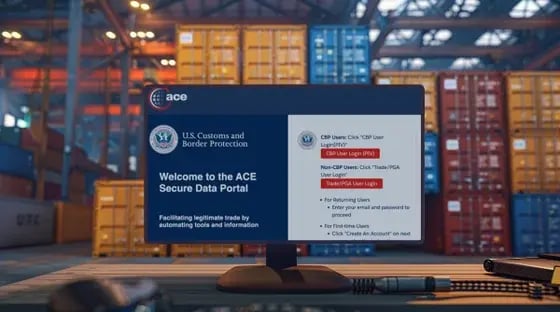 As an exporter, you’ve no doubt encountered the requirement to electronically submit your export information through the Automated Export System (AES) through the Automated Commercial Environment (ACE) portal. The U.S. Foreign Trade Regulations (FTR) govern who must file the information, when filings are required and what information must be submitted.
Not every export requires an AES filing. The filing isn’t always done by the exporter. And the timing of the filing can vary, depending on the circumstance. The information that is submitted—which the FTR calls electronic export information (EEI)—is used by the U.S. Census Bureau for statistical purposes and shared with other agencies to help ensure compliance with U.S. export regulations.
This FAQ is designed as a quick reference for exporters who already understand the basics. You’ll find a detailed explanation of when and how to file through AES on our webpage: Filing Your Export Shipments through the Automated Export System.
Below are answers to some of the most common questions exporters ask about AES filing:
Q: Who are the parties to an export transaction?
The Foreign Trade Regulations define several key parties involved in export transactions, each with a specific role:
- Carrier: The entity responsible for transporting the goods, such as an airline, trucking company, rail carrier or ocean vessel operator.
- Foreign Principal Party in Interest (FPPI): The party located abroad who purchases the goods or ultimately receives them.
- Intermediate Consignee: A foreign-based agent who takes physical possession of the goods to facilitate delivery to the ultimate consignee.
- Ultimate Consignee: The final recipient of the goods, as known at the time of export.
- U.S. Authorized Agent: A party authorized by the USPPI or FPPI to prepare and file the EEI.
- U.S. Principal Party in Interest (USPPI): The person or entity in the United States that receives the primary benefit from the export transaction.
Q: Who is the USPPI?
The USPPI is the person or entity in the United States that receives the primary benefit from the export transaction.
In most cases, this is the U.S. seller or manufacturer. However, depending on how the transaction is structured, the USPPI may also be a distributor, order party or other U.S.-based entity involved in the sale.
The FTR outlines several common scenarios:
- If a U.S. manufacturer sells directly to a foreign buyer, the manufacturer is the USPPI.
- If a U.S. wholesaler or distributor purchases goods domestically and then exports them, the distributor is the USPPI.
- If a U.S. order party arranges the export sale, that party may be the USPPI.
- In certain temporary import scenarios, a customs broker or warehouse may be designated as the USPPI depending on control and timing.
- If a foreign entity is in the U.S. when they purchase or obtain the goods, they are the USPPI.
Q: Who is responsible for filing EEI?
Responsibility for filing EEI depends on whether the transaction is standard or routed.
In a standard export transaction, the USPPI is responsible for filing EEI or authorizing an agent to file on their behalf.
In a routed export transaction, the FPPI authorizes a U.S. agent—often a freight forwarder, but it could also be the USPPI—to file the EEI. If the USPPI is not doing the filing they still have specific data reporting responsibilities and must provide accurate information to the filing party.
Q: When is EEI filing required?
EEI filing is required for most exports valued at more than $2,500 per Schedule B number or when an export license is required, regardless of value. Exports to Canada are generally exempt from filings unless the shipment involves a used self-propelled vehicle or otherwise falls under one of the mandatory filing triggers in the FTR.
There are also specific categories of exports that always require filing, including:
- Shipments requiring an export license from the U.S. Department of Commerce or State
- Items subject to ITAR
- Used self-propelled vehicles
- Certain firearms shipments
- Exports of items with specific Export Control Classification Numbers (ECCNs), including “600 series” and “9x515 series”
- Shipments under license exceptions such as STA and VEU
The origin of the goods also matters. If items share a Schedule B number but differ in origin (domestic vs. foreign), the filing requirement is evaluated separately by origin.
Q: Do I need to file EEI for shipments under $2,500?
EEI filing is generally not required for shipments valued at $2,500 or less per Schedule B number, unless another requirement applies.
For example, you must still file EEI if:
- The shipment requires an export license
- The goods fall under ITAR
- The shipment includes regulated items such as vehicles or certain controlled products
This is one of the most common areas of confusion—value alone does not determine filing requirements.

Q: To which destinations is EEI filing required?
EEI must be filed for shipments involving the following destinations:
- Shipments from the U.S. to foreign countries
- Shipments from the U.S. to the U.S. Virgin Islands
- Shipments from the U.S. Virgin Islands to foreign countries
- Shipments from Puerto Rico to foreign countries
- Shipments from Puerto Rico to the U.S. Virgin Islands
- Shipments from the U.S. to Puerto Rico
- Shipments from Puerto Rico to the U.S.
Exports to Canada are generally exempt from EEI filing requirements unless the shipment involves a used self-propelled vehicle or otherwise falls under one of the mandatory filing triggers in the FTR.
Q: What is a shipment?
For EEI purposes, a shipment consists of all goods sent from one USPPI to one ultimate consignee in a single country on the same conveyance and on the same day.
This definition is important because filing requirements are evaluated at the shipment level, including the total value per Schedule B classification.
Q: How soon do you have to file your EEI?
EEI must typically be filed before the goods depart the United States, with timing requirements based on the mode of transportation.
For most shipments, filing occurs between one and 24 hours prior to export. Shipments involving items on the U.S. Munitions List (USML) may require earlier filing.
Because timing requirements vary, exporters should confirm deadlines based on the specific shipment and transportation method.
Q: What is an ITN and when do you receive it?
An Internal Transaction Number (ITN) is the confirmation number issued by AES after a successful EEI filing.
The ITN serves as proof that the filing has been accepted and must be included on export documentation provided to the carrier. Without a valid ITN, the shipment may be delayed or rejected at export.
Q: Can a freight forwarder file EEI on my behalf?
Yes, a freight forwarder can file EEI on your behalf if they are properly authorized as your agent.
In a standard transaction, the USPPI must provide written authorization. In a routed transaction, the FPPI typically authorizes the forwarder, although they can also authorize the USPPI, which some companies consider to be a best practice. Regardless of who files, the USPPI remains responsible for providing accurate and complete information.
Q: When is EEI filing not required?
EEI filing is not required for certain types of shipments, provided no other filing trigger applies.
Common exemptions include:
- Shipments valued at $2,500 or less per Schedule B number
- Tools of the trade used temporarily abroad
- Certain in-transit shipments through the U.S.
- Shipments of publicly available information or certain software
- Specific humanitarian or gift shipments under license exception GFT
- Most shipments to Canada
Additional exemptions are outlined in Section 30.37 of the FTR.

Q: What happens if I file EEI late or incorrectly?
Late or inaccurate EEI filings can result in significant civil and criminal penalties.
Civil penalties are adjusted for inflation and can exceed $15,000 per violation. Criminal violations may result in higher fines and potential imprisonment. Late filings may also result in daily penalties.
Beyond fines, inaccurate filings can lead to shipment delays, increased scrutiny and broader compliance risks.
Q: How do I submit an EEI filing to AES?
EEI filings are submitted electronically through AESDirect, which is accessed via the Automated Commercial Environment (ACE) portal.
You can enter shipment data manually into AESDirect, or you can use export documentation software that integrates with AES. Many exporters choose software solutions to reduce manual data entry, minimize errors and maintain consistent compliance records.
If you want to learn how Shipping Solutions export software can help your company file through AES more efficiently while also creating your other export documents and staying compliant with export regulations, request a free online demo of the software. There is no obligation.
Q: Who do I contact for support with AES?
You’ll find more information about the Automated Export System and the Foreign Trade Regulations at the Census Bureau website. Or contact the Census Bureau by phone:
- For questions about your ACE account, call the ACE Account Service Desk at (866) 530-4172, option 1.
- General questions about EEI filings can be directed to the U.S. Census Bureau’s Data Collection Branch at (800) 549-0595, option 1.
If you have questions about how Shipping Solutions software can help streamline your AES filings and export documentation, you can contact our team directly at (651) 905-1727.
Final Thought
If you’re filing EEI regularly, you already know that the challenge isn’t just understanding the rules—it’s applying them consistently across shipments, teams and systems.
That’s where having a reliable process—and the right tools—can make a measurable difference.
Like what you read? Join thousands of exporters and importers who subscribe to Passages: The International Trade Blog. You'll get the latest news and tips for exporters and importers delivered right to your inbox.