The International Trade Blog  Export Compliance
Do I Need an Export License? Understanding ECCNs, Reasons for Control and License Exceptions
On: July 13, 2026 | By:  Kari Crane |
13 min. read
Kari Crane |
13 min. read

Does my product require an export license? That’s a question you should ask before every export.
The quickest way to determine whether your product needs an export license is to identify the item’s Export Control Classification Number, or ECCN; check the reasons for control listed in that ECCN; compare those controls against the destination country using the Commerce Country Chart; and then review whether any license exception applies. You must also screen the end user and confirm the end use, because those factors can trigger a license requirement even when the ECCN and destination do not.
To begin the process, you first need to answer two preliminary questions:
- What is the Export Control Classification Number (ECCN) of the product?
- What is the destination country?

ECCNs are found in the Commerce Control List (CCL), which is part of the Department of Commerce’s Export Administration Regulations (EAR). BIS describes an ECCN as a five-character alphanumeric designation used to identify items for export control purposes. An ECCN is different from a Schedule B number or Harmonized Tariff Schedule, or HTS, code. Schedule B and HTS codes are used for statistical and tariff purposes; ECCNs are used for export control purposes.
Picking the right ECCN requires that you understand the technical characteristics of the product you’re shipping. You can spend hours manually paging through the Commerce Control List to find the ECCNs of your products, or you can use a tool like the Shipping Solutions Product Classification Software (free trial) to make your search process both more efficient and more thorough.
Different government agencies have jurisdiction over different types of exports. This article is only concerned with exports that fall under the jurisdiction of the Commerce Department’s Bureau of Industry and Security (BIS), the agency that controls most items subject to the EAR. For more information about State Department regulations, read Understanding ITAR: The International Traffic in Arms Regulations.
Reasons for Control
Each ECCN has associated reasons for control. These are the reasons why the export of the product is controlled; in other words, they explain why the product might require an export license. Here's an example of what you'd see in the Commerce Control List for the ECCN 1A001:
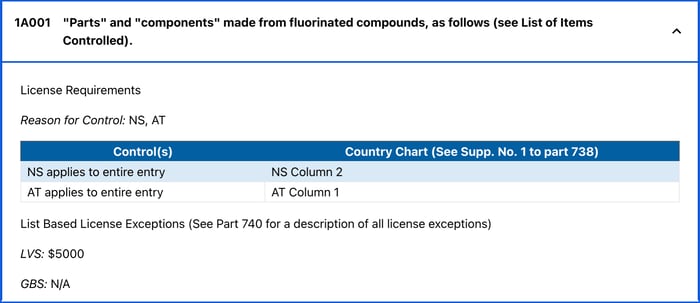
Common reasons for control include national security, nuclear nonproliferation, missile technology, regional stability, crime control and anti-terrorism. These reasons appear in the License Requirements section of an ECCN, as shown above.
Once you know the ECCN and the destination country, you can begin determining whether your product needs an export license. BIS explains that exporters should use the License Requirements section of the ECCN in combination with the Commerce Country Chart to decide whether a license is required, although not every license requirement is determined by the Country Chart. Some ECCNs refer exporters to other sections of the EAR for additional requirements.
Using the Commerce Country Chart
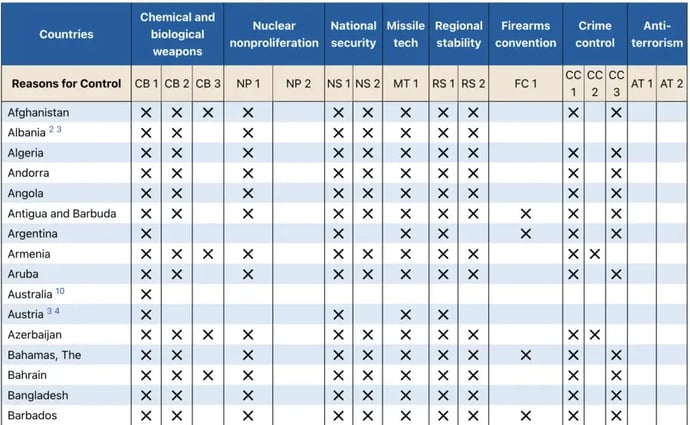
The manual way of determining whether you need a license involves comparing the reasons for control listed in the ECCN against the destination country using the Commerce Country Chart, which appears in Supplement No. 1 to Part 738 of the EAR.
BIS also offers an Interactive Commerce Country Chart that allows exporters to select the destination country and review the reasons for control to help determine whether a license is required.
Here’s a simplified example:
Suppose your product is classified under an ECCN that is controlled for National Security reasons, shown as NS. You would check the Commerce Country Chart for the destination country and the applicable NS column. If there is an “X” in that column for the destination, a license is required unless a license exception is available and all conditions for using that exception are met.
If there is no “X,” the item may be eligible for No License Required, often abbreviated as NLR. However, that does not end your export compliance responsibilities. You still need to screen the parties to the transaction, confirm the end user and understand the end use.
I outline the manual process in more detail in my article, How to Use the Commerce Country Chart to Determine if You Need an Export License.
Using Export Compliance Software
Manually checking the Commerce Country Chart can work, but it is time-consuming and easy to get wrong, especially if you export multiple products to multiple countries.
Shipping Solutions Professional export documentation software includes an Export Compliance Module with an Export License Determination tool. At the click of a button, this tool screens your products and the country of destination against the EAR, helping create a more efficient and thorough screening process than manually checking the Commerce Country Chart for every shipment.
If you classify products, screen parties and check license requirements regularly, Shipping Solutions Trade Compliance Software can help automate product classification, restricted party screening and export controls checks so your team does not have to rely on manual lookups for every transaction.

License Exceptions
Just because an ECCN and destination combination indicates that a license is required does not always mean you must apply for an individual export license. In some cases, a license exception may be available.
A license exception is a specific authorization in Part 740 of the EAR that allows an exporter to ship, reexport or transfer an item without applying for an individual license, as long as every condition of the exception is met. The EAR makes clear that by using a license exception, the exporter is certifying that the terms and conditions for using that exception have been satisfied.
That is important: License exceptions are not blanket exemptions. You cannot use a license exception simply because it appears in an ECCN. You must confirm that the product, destination, end user, end use and transaction details all qualify.
Shipping Solutions Professional’s Export License Determination tool provides information on reasons for control and license exceptions that may be available for your exports. For a broader overview, see our article A Beginner’s Guide to Export License Exceptions.
Other Considerations
Four factors play a role in determining whether you need an export license. In this article, we’ve covered two:
- The technical characteristics of the product, as communicated in the form of an ECCN.
- The destination country.
Two other factors are just as important:
- The end user, meaning the identity of the party that will ultimately receive the goods.
- The end use, meaning how the goods will actually be used.
BIS warns that end-user restrictions may apply broadly to both EAR99 items and items on the Commerce Control List, even when no license would otherwise be required based on the item’s classification or destination. End-use controls may also trigger a license requirement based on how the item will be used.
That means an export can still require a license even if the product seems low risk or is classified as EAR99. For example, a shipment may require a license if the buyer, consignee, intermediate consignee or end user appears on a restricted party list, or if you know the item will be used in a prohibited activity.
We explain those factors in more detail in the article Export Compliance: The Importance of Knowing End Use and End Users.

Glossary of Reasons for Control and License Exceptions
The U.S. government uses acronyms as shorthand to identify reasons for control and license exceptions. The list of license exceptions and reasons for control can change, so exporters should always confirm availability in the current EAR Part 740 and in the specific ECCN before relying on one.
Common Reasons for Control
AT—Anti-Terrorism
Controls related to U.S. anti-terrorism policy.
CB—Chemical and Biological Weapons
Controls related to chemical and biological weapons concerns.
CC—Crime Control
Controls related to crime control and detection items.
CW—Chemical Weapons Convention
Controls related to Chemical Weapons Convention obligations.
EI—Encryption Items
Controls related to certain encryption commodities, software and technology.
FC—Firearms Convention
Controls related to certain firearms and related items.
MT—Missile Technology
Controls related to missile technology concerns.
NS—National Security
Controls related to national security concerns.
NP—Nuclear Nonproliferation
Controls related to nuclear nonproliferation.
RS—Regional Stability
Controls related to regional stability concerns.
SS—Short Supply
Controls related to items in short supply.
UN—United Nations Embargo
Controls related to United Nations embargoes.
SI—Significant Items
Controls related to certain significant items.
SL—Surreptitious Listening
Controls related to certain listening or surveillance items.
Common License Exceptions
LVS—Shipments of Limited Value
Allows certain low-value shipments when the ECCN and destination qualify.
GBS—Shipments to Country Group B Countries
Applies to certain shipments to eligible Country Group B destinations.
TSR—Technology and Software Under Restriction
Applies to certain technology and software exports under defined conditions.
APP—Computers
Applies to certain computer exports and reexports.
TMP—Temporary Imports, Exports, Reexports and Transfers
Applies to certain temporary movements of items, including tools of trade in some situations.
RPL—Servicing and Replacement of Parts and Equipment
Applies to certain parts, components and equipment used for servicing or replacement.
GOV—Governments, International Organizations, International Inspections Under the Chemical Weapons Convention, and the International Space Station
Applies to certain qualifying government, international organization and inspection-related transactions.
GFT—Gift Parcels and Humanitarian Donations
Applies to certain gift parcels and humanitarian donations.
TSU—Technology and Software Unrestricted
Applies to certain publicly available or otherwise eligible technology and software.
BAG—Baggage
Applies to certain personal baggage exports and reexports.
AVS—Aircraft, Vessels and Spacecraft
Applies to certain aircraft, vessel and spacecraft-related transactions.
APR—Additional Permissive Reexports
Applies to certain reexports that meet the conditions of the exception.
ENC—Encryption Commodities, Software and Technology
Applies to certain encryption items when the requirements of the EAR are met.
AGR—Agricultural Commodities
Applies to certain agricultural commodity exports and reexports.
STA—Strategic Trade Authorization
Applies to certain exports, reexports and transfers to eligible destinations when detailed conditions are met.
SCP—Support for the Cuban People
Applies to certain exports and reexports intended to support the Cuban people.
Because license exceptions are detailed and fact-specific, never rely on the acronym alone. Always review the full license exception requirements before using one.
The Bottom Line
Determining whether your product requires an export license is not a one-step process. You need to know the product’s ECCN, the reasons for control, the destination country, the end user and the end use. You also need to determine whether a license exception is available and whether your transaction meets all of its requirements.
Manual research can work, but it can be slow and error-prone. Shipping Solutions software helps exporters classify products, screen restricted parties, check export controls and create accurate export documents, helping reduce the risk of missed license requirements and costly compliance mistakes.
For more information about the export license process, download our free guide: How to Determine If You Need an Export License.
Like what you read? Join thousands of exporters and importers who subscribe to Passages: The International Trade Blog. You'll get the latest news and tips for exporters and importers delivered right to your inbox.
This article, first written by Arnesh Roy and published in October 2018, has been updated to include current information, links and formatting.