The International Trade Blog  Export Compliance
Understanding Reasons for Control Under the Export Administration Regulations (EAR)
On: February 18, 2026 | By:  Kari Crane |
10 min. read
Kari Crane |
10 min. read
.webp?width=560&height=373&name=Understanding%20Reasons%20for%20Control%20Under%20the%20Export%20Administration%20Regulations%20(EAR).webp) Before you can export most commercial or dual-use items from the United States, you need to determine whether an export license is required. This process is governed by the Export Administration Regulations (EAR), which are administered by the U.S. Department of Commerce’s Bureau of Industry and Security (BIS).
Before you can export most commercial or dual-use items from the United States, you need to determine whether an export license is required. This process is governed by the Export Administration Regulations (EAR), which are administered by the U.S. Department of Commerce’s Bureau of Industry and Security (BIS).
The first step is identifying your product’s Export Control Classification Number (ECCN) on the Commerce Control List (CCL). Once you know the ECCN, the next step is to determine whether a license is required based on the reasons for control associated with that ECCN and the destination country.
This article focuses on that second step: understanding the reasons for control listed in Part 742 of the EAR.
Reasons for control explain why the U.S. government restricts exports of certain items to certain countries—whether for national security, anti-terrorism, regional stability or to prevent the spread of weapons of mass destruction.
Many ECCNs include multiple reasons for control, and license requirements vary by destination based on the Commerce Country Chart. In addition, even if an item’s ECCN doesn’t require a license on its own, your export may still be subject to review based on the end use, end user, or country of destination.
For example:
- Any export involving Missile Technology (MT), Nuclear Nonproliferation (NP) or Chemical and Biological Weapons (CB) may require additional scrutiny based on how the item will be used and by whom.
- Exports to countries designated as supporting terrorism are also subject to Anti-Terrorism (AT) controls, regardless of item classification.
In the sections below, you’ll find a brief overview of the most-used EAR reasons for control. This summary is not comprehensive—always refer to EAR Part 742 for the full text of the regulations and specific licensing requirements.
(And if the beginning of this article already feels overwhelming, don’t worry. Our free guide, How to Determine If You Need an Export License, will walk through the first steps before you read on.)
 EAR Reasons for Control: A Quick Guide
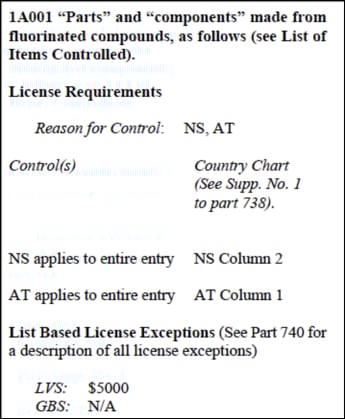
If you're new to export compliance, the abbreviations and acronyms can be overwhelming. Each reason for control—two-letter codes like AT, CB or NS—reflects a specific U.S. national security or foreign policy objective, and many ECCNs include multiple reasons. (Anti-Terrorism and National Security are the most commonly used controls.)
Here’s a brief overview of the reasons for control:
AT—Anti-Terrorism
Applies to exports to countries designated as sponsors of terrorism (currently Iran, Syria and North Korea). Exporters must also consult Part 746 and the Department of Treasury’s Office of Foreign Assets Control (OFAC) for sanctions and licensing requirements.
CB—Chemical and Biological Weapons
Covers items that could assist in the development or production of chemical or biological weapons, including lab equipment, toxins and related technology. License applications for exports controlled under reason CB will be evaluated on a case-by-case basis to determine whether the export or re-export would contribute to the design, development, production or stockpiling of chemical or biological weapons.

CC—Crime Control and Detection
Controls certain law enforcement and military-use items (e.g., restraint devices, police-model IR viewers) to prevent human rights abuses. Items like implements of torture (ECCN 0A983) require a license to all destinations, including Canada.
CW—Chemical Weapons Convention
Implements U.S. obligations under the Chemical Weapons Convention treaty. Covers toxic chemicals and precursors identified as chemical weapons, even when they have commercial uses.
EI—Encryption Items
Encryption hardware and software are controlled based on their capability to secure communications. Many items may qualify for license exceptions, but some require BIS notification or license.
FC—Firearms Convention
Applies to firearms and ammunition exports to the Organization of American States (OAS) member countries under the Inter-American Convention Against the Illicit Manufacturing of and Trafficking in Firearms, Ammunition, Explosives, and Other Related Materials. Requires a Firearms Convention (FC) Import Certificate or equivalent from the destination country.
MT—Missile Technology
Covers rocket systems and UAVs capable of delivering a 500 kg payload over 300 km. Strict controls apply to prevent WMD proliferation.
NP—Nuclear Nonproliferation
Dual-use commodities on the Commerce Control List that are subject to nuclear non-proliferation export licensing controls are collectively referred to as the Nuclear Referral List (NRL). Applies to items that could contribute to nuclear weapons programs. BIS considers the item, end use, end user and destination country’s compliance history. The Commerce Country Chart includes NP1 and NP2 designators to distinguish how controls apply by destination. These distinctions affect license requirements, even for items not on the NRL.
NS—National Security
Protects sensitive U.S. technology from being diverted to adversaries. Applies to exports to countries in Country Group D:1, which are considered a potential national security risk.
RS—Regional Stability
Supports U.S. foreign policy goals to maintain peace in sensitive regions. Controls apply to certain electronics, imaging systems and spacecraft-related items. The Commerce Country Chart uses RS1 and RS2 to identify countries subject to different levels of regional stability controls. Be sure to consult the chart for country-specific requirements.
SI—Significant Items
Covers high-performance aircraft engine components and related technology. License required to all destinations except Canada.
SL—Surreptitious Listening
Applies to items that can intercept oral, wire or electronic communications without detection. Licenses are required for all destinations, including Canada.

Other Reasons for Control
While Part 742 includes most EAR reasons for control, it’s not the whole picture.
Additional controls include:
- SS—Short Supply: Found in Part 754, covering limited U.S. commodities like petroleum products and unprocessed cedar.
- UN—United Nations Sanctions: Detailed in Part 746, covering embargoed countries and arms embargoes.
End Use and End User Controls: What They Mean for Exporters
End use and end user are also potential reasons for control in their own right. Even if your product’s ECCN and destination don’t require a license under the Commerce Country Chart, you’re not necessarily in the clear. That’s because the end use of the item and the end user—the person or organization receiving it—can trigger licensing requirements under Part 744 of the EAR.
These controls are based not on the item itself, but on how it will be used and who is receiving it.
- End use refers to the intended application of the exported item.
- End user refers to the individual, company or entity that will ultimately receive or operate the item.
Examples:
- You export a high-precision machine tool designed for civilian manufacturing. But if it’s destined for use in a nuclear weapons program, the transaction may be prohibited or require a license based on end use controls.
- You receive a purchase order from a legitimate-sounding overseas distributor. But after performing restricted party screening, you discover the company is listed on the Entity List or Denied Persons List due to prior violations. This triggers end user controls.
Shipping Solutions software makes it easy to stay compliant with end user controls. Give our Restricted Party Screening Software a try here for free.
Export License Exceptions
License exceptions are specific criteria that, if met, enable an exporter to ship without a license even when one or more reasons for control apply to their export. Just like reasons for control, license exceptions are codified in the EAR. We explain license exceptions in detail in our article What You Need to Know about Export License Exceptions. Or, this video walks you through the steps you need to follow to determine if there are any restrictions on your exports and what license exceptions may be available:
When in Doubt, Check the EAR—and Get Expert Help
Export controls can be complex. As you've seen, the EAR include a range of reasons why your product might require a license, from where it's going, to how it’s used, to who’s receiving it.
This article is just an introduction. We haven’t covered every nuance—like how National Security (NS) controls apply differently to exports to China and Russia versus India, or how temporary ECCNs like 0Y521 are handled. The reality is that export license requirements depend on many interconnected factors, and the consequences of getting it wrong can be serious.
If you’re unsure whether your exports are controlled, the best thing you can do is follow the license determination process step-by-step and consult the official regulations. You can read the full EAR on the Bureau of Industry and Security’s website.
Or better yet, let Shipping Solutions help. Our Export Documentation and Compliance Software combines powerful export documentation tools with built-in compliance features like:
- Export license determination
- Restricted party screening
- Automated AES filing
It’s the all-in-one solution for exporters who want to streamline paperwork and stay compliant.
Just Need Compliance Tools?
If you're not managing export documents but still need to protect your company from violations, our standalone Trade Compliance Software is the perfect fit. These web-based tools help you:
- Classify products with ECCN, USML, HTS and Schedule B codes
- Screen customers against denied party lists
- Calculate landed costs and assess duty exposure
- Determine which import and export controls apply to your products
Let us show you how the right software can help you export with confidence. Give our standalone compliance tools a try for free, or schedule a free demo to learn how we can help you.
Like what you read? Subscribe today to the International Trade Blog to get the latest news and tips for exporters and importers delivered to your inbox.