The International Trade Blog  Export Compliance
How to Use the Commerce Country Chart to Determine If You Need an Export License
On: March 4, 2026 | By:  Kari Crane |
11 min. read
Kari Crane |
11 min. read

Before you can legally export many commercial or dual-use goods from the United States, you need to determine whether an export license is required. This process is governed by the Export Administration Regulations (EAR) and enforced by the Bureau of Industry and Security (BIS) at the U.S. Department of Commerce.
One of the most important tools in this process is the Commerce Country Chart, which helps exporters determine if a license is needed based on the destination country and the reasons for control tied to a product’s classification.
But here’s the catch: The Commerce Country Chart is only one part of a multi-step license determination process. To use it correctly, you must first:
- Classify your product by identifying its Export Control Classification Number (ECCN) on the Commerce Control List (CCL)
- Identify the applicable reasons for control listed under that ECCN
- Use the Commerce Country Chart to check if any of those controls apply to your product’s destination
This article walks you through step three: how to read and apply the Commerce Country Chart so you can quickly and confidently determine if your export needs a license.
If you're unsure about ECCNs, reasons for control or how to start the process, download our free guide: How to Determine If You Need an Export License before you keep reading.
Note: If you don't know if your goods fall under the EAR or who has jurisdiction over your exports, read the blog post, Determining Export Controls Jurisdiction and Classification: ITAR and EAR Order of Review.

What Is the Commerce Country Chart?
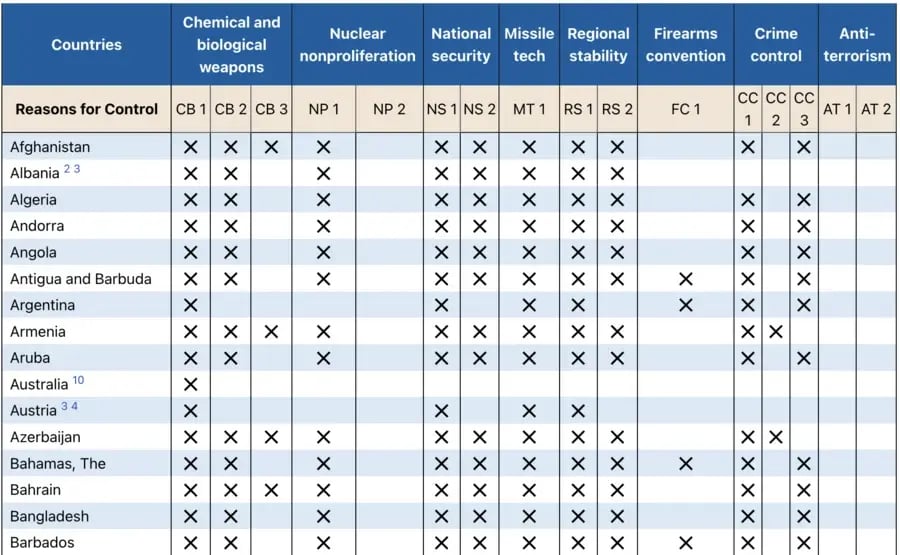
The Commerce Country Chart is a reference table published by BIS that helps determine whether an export license is required based on the destination country and the reasons for control listed on a product’s ECCN.
You can find the current chart in Supplement No. 1 to Part 738 of the EAR, which lists nearly every country in the world in rows, and control codes (like NS, AT, CB, MT, etc.) in columns.
Each ECCN on the CCL includes one or more reasons for control—such as National Security (NS) or Anti-Terrorism (AT)—and tells you which control column(s) apply. You then look up the destination country in the chart to see if there’s an "X" under that column.
- If there’s an "X", a license is required for that reason for control.
- If the space is blank, a license is not required—unless other restrictions apply (like end-use or end-user concerns).
This chart is essential to navigating U.S. export regulations, but it only works if you've already identified your ECCN and the correct reasons for control.
In the next section, we’ll walk through an example to show exactly how this process works in practice.
Example: Using the Country Chart for ECCN 1A001 and Algeria
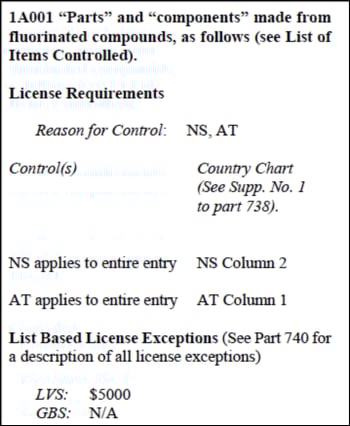 Let’s say you’re exporting parts and components made from fluorinated compounds to Algeria.
1. Classify the product:
- These items fall under ECCN 1A001 on the Commerce Control List.
- This ECCN covers certain materials and equipment related to chemical and biological protection.
2. Identify reasons for control:
- ECCN 1A001 is controlled for:
- National Security (NS Column 2)
- Anti-Terrorism (AT Column 1)
3. Check the Commerce Country Chart:
- Look up Algeria on the country chart.
- Under NS Column 2, you’ll see an “X”, meaning a license is required.
- Under AT Column 1, there is no “X”, meaning no license is required for that reason.
Conclusion: Because NS Column 2 applies and Algeria has an “X” in that column, you must obtain an export license for this item—even though AT does not apply.

Why End Use and End User Still Matter
The Commerce Country Chart helps determine license requirements based on the destination country and your product’s reasons for control, but it’s not the full picture.
Even if the chart shows that no license is required, you may still need one based on the end use of your item or the end user receiving it. These controls are outlined in Part 744 of the EAR, and they exist to prevent U.S. exports from contributing to the development of:

- Nuclear, chemical, or biological weapons
- Missile technology or delivery systems
- Military activity in embargoed or sanctioned regions
- Human rights abuses or terrorist activities
Examples:
- You're exporting a machine tool classified as EAR99 to a buyer in a non-restricted country. But if it will be used in a nuclear weapons program, a license is still required—even though it wouldn’t be under the Country Chart.
- You screen your customer and discover they appear on the Entity List, Denied Persons List or Specially Designated Nationals (SDN) list. That triggers a license requirement or outright prohibition, depending on the list.
These rules are enforced regardless of ECCN or destination. If you need help screening the parties in your export transaction, register for a free trial subscription of our Restricted Party Screening Software here.
What About EAR99 and NLR?
Not every export requires an ECCN or appears on the CCL. In fact, many commercial items fall into a catch-all category known as EAR99.
What is EAR99?
EAR99 is a classification for items that are subject to the EAR but are not specifically listed on the CCL. These items are generally considered low risk and typically do not require a license—unless:
- The destination country is embargoed (e.g., Iran, North Korea)
- The end use is prohibited (e.g., nuclear weapons development)
- The end user is on a restricted or denied party list
What does NLR mean?
NLR stands for No License Required, and it’s commonly used in two scenarios:
- The item is classified as EAR99 and none of the restrictions above apply
- The item is listed on the CCL, but the Commerce Country Chart shows no license requirement for the destination country and no other restrictions apply
When you file through AES, the license type “C33” is used to indicate an NLR shipment. This is not a license, but it documents that a license wasn’t required under the EAR.
When in Doubt, Let the EAR—and the Right Tools—Guide You
Determining whether you need an export license isn’t just about the product or the destination—it’s about the full context of the transaction. You need to consider:
- The technical specifications of the item (ECCN)
- The reasons for control
- The destination country (via the Commerce Country Chart)
- The end use and end user
- Any applicable license exceptions
Even when an item seems low risk, like those classified as EAR99, you’re still responsible for screening parties and understanding potential red flags.
This article focused on just one part of the puzzle: using the Commerce Country Chart to interpret reasons for control and country-specific license requirements. If you're unsure about ECCNs, license exceptions or restricted party screening, be sure to check out our free guide: How to Determine If You Need an Export License.
And if you’re tired of spending hours manually reviewing the CCL and Commerce Country Chart, let Shipping Solutions Trade Compliance Software do it for you.
With our tools, you can:
- Classify products by ECCN
- Quickly determine license requirements
- Screen parties against 300+ denied and restricted party lists
- Identify license exceptions
Try our Trade Compliance Software tools here for free.
Like what you read? Subscribe today to the International Trade Blog to get the latest news and tips for exporters and importers delivered to your inbox.
This article, first written by Arnesh Roy and published in 2016, has been updated to include current information, links and formatting.