The International Trade Blog  Export Forms
Export Packing List: What It Is and Why It Matters
On: June 8, 2026 | By:  Kari Crane |
13 min. read
Kari Crane |
13 min. read

A smooth export shipment depends on more than getting the goods out the door. Every package must be identified, documented and matched to the rest of your export paperwork so freight forwarders, carriers, customs officials and customers know exactly what is being shipped.
That is where the export packing list comes in.
While the commercial invoice explains the sale, the packing list explains the shipment. It helps answer practical questions that can delay a delivery if they are unclear: How many packages are included? What is inside each one? How much do they weigh? How are they marked? And where can a specific item be found?

What Is an Export Packing List?
An export packing list is a detailed international shipping document that shows what is packed in each carton, crate, drum, pallet or other package. It identifies the merchandise, package count, weights, measurements, package markings and shipment references needed by your customer, freight forwarder, carrier, bank and customs officials. You'll find a free export packing list template here.
The International Trade Administration notes that packing lists are used by freight forwarders to determine weights and freight costs and by U.S. and foreign customs officials to check package contents.
Your freight forwarder may use the packing list to prepare the bill of lading and other transportation documents. They may also use shipment details to help prepare export clearance information, including the Electronic Export Information (EEI) that is filed through AESDirect in the Automated Commercial Environment (ACE) when required.
A packing list can also help:
- Support customs clearance in the destination country.
- Help carriers verify cargo details.
- Provide evidence in a dispute about package count, measurements or weight.
- Support an insurance or carrier claim if cargo is damaged or lost.
- Satisfy buyer, bank or letter of credit requirements.
If the term of payment is a letter of credit, the issuing bank may require a packing list to be presented exactly as instructed by the buyer.

What to Include on an Export Packing List
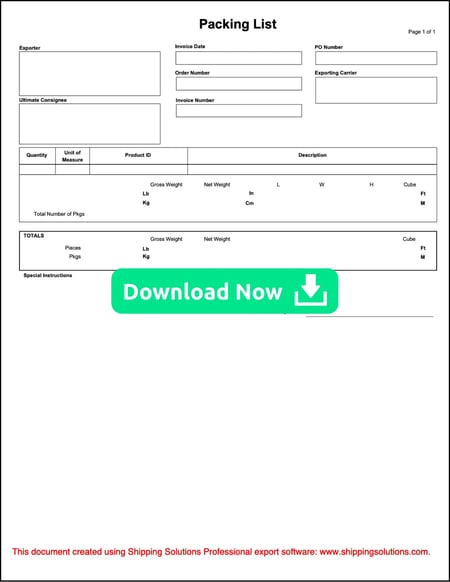 A good export packing list provides enough detail for someone to identify what is in each package without opening every carton. Include:
- Exporter, consignee and buyer information.
- Reference to the related commercial invoice, purchase order or sales order.
- Product descriptions.
- Quantity of goods in each package.
- Type of package, such as carton, crate, drum, pallet or box.
- Package count.
- Net weight, gross weight and, when useful, tare weight.
- Dimensions and total cubic measurements.
- U.S. and metric units, unless the buyer or destination-country rules require a different format.
- Package marks and numbers.
- Any special handling notes.
Use clear, specific product descriptions. CBP guidance on cargo descriptions emphasizes that descriptions should be plain-language and detailed enough to identify the size, shape and characteristics of the commodity.
Export Packing List vs. Commercial Invoice
The commercial invoice is the primary accounting and customs valuation document. It includes the buyer and seller, product value, Incoterms, payment terms and other information used to determine duties and taxes.
The packing list focuses on how the goods are packed. It shows the contents, weight, dimensions and markings for each package.
The two documents should match where they overlap, including product descriptions, quantities, invoice numbers and buyer/seller references. Inconsistencies can delay customs clearance, create questions from the buyer or cause problems with a letter of credit.
Export Packing List vs. Pick List
A packing list is not the same as a pick list.
A pick list is an internal warehouse document that tells your team what to pull from inventory.
An export packing list is an external shipping document that tells forwarders, carriers, customs officials and customers how the goods are packed for international transportation.
The pick list helps you prepare the order. The packing list helps move and verify the shipment.
Common Packing List Mistakes to Avoid
Small packing list errors can cause big shipment problems. Watch for these common mistakes:
- Listing totals only instead of showing what is inside each package.
- Using vague product descriptions.
- Forgetting package marks and numbers.
- Showing weights or dimensions that do not match the actual shipment.
- Failing to match the commercial invoice.
- Omitting metric equivalents when they are expected.
- Reusing an old packing list without updating quantities, weights or package counts.
Where Should the Packing List Go?
The packing list should be available to the parties that need it. Many exporters include a copy inside the package and attach another copy to the outside in a document pouch. ITA guidance notes that a packing list should be included in the carton or package and may be attached to the outside with a copy inside.
Also send a digital copy to your freight forwarder, customer and any other party named in the transaction instructions.
Create Export Packing Lists Faster
The packing list is an important document for you, your customer, your freight forwarder, the carrier and customs officials. Accurate details help move your goods efficiently and reduce the risk of delays, claims and costly documentation errors.
Shipping Solutions export documentation software helps exporters create accurate packing lists and other export documents from the same shipment data, reducing redundant data entry and keeping information consistent across forms. With Shipping Solutions, you can also import orders from your company's ERP system, file through AES and run compliance checks before shipping.
Like what you read? Subscribe today to the International Trade Blog to get the latest news and tips for exporters and importers delivered to your inbox.
This post, originally written by Catherine J. Petersen, was published in June 2002 and has been updated to include current information, links and formatting.