

The International Trade Blog  Export Forms
When Should You Refuse to Complete the USMCA Certificate of Origin?
On: March 24, 2025 | By:  David Noah |
8 min. read
David Noah |
8 min. read
.webp?width=560&height=373&name=When%20SHould%20You%20%20Refuse%20to%20Complete%20the%20NAFTA%20Certificate%20of%20Origin%20(1).webp) The United States-Mexico-Canada Agreement (USMCA) replaced NAFTA on July 1, 2020. It allows qualifying goods traded among the three countries to receive preferential tariff treatment—but that doesn’t mean every exporter should provide a USMCA Certification of Origin every time a customer requests one.
The United States-Mexico-Canada Agreement (USMCA) replaced NAFTA on July 1, 2020. It allows qualifying goods traded among the three countries to receive preferential tariff treatment—but that doesn’t mean every exporter should provide a USMCA Certification of Origin every time a customer requests one.
This is more than a paperwork decision. By completing the certification, you assume responsibility for the accuracy of the claim and for providing supporting documentation if customs authorities conduct a verification. Rather than rushing blindly into preparing USMCA Certificates of Origin, now may be a good time for exporters to reassess whether utilizing USMCA makes financial and operational sense amid changing tariff policies.
Is USMCA Still in Effect After the 2026 Review?
Yes. USMCA remains in effect.
During the agreement’s first joint review on July 1, 2026, the United States did not agree to extend USMCA for another 16-year term in its current form. However, that decision did not terminate the agreement or eliminate its tariff benefits.
Under Article 34.7 of USMCA, the three countries will now conduct annual reviews beginning in 2027. Unless all three countries later agree to extend it, USMCA is scheduled to expire July 1, 2036.
For now, qualifying goods can continue to receive USMCA preferential tariff treatment, and the existing certification requirements remain in place. However, exporters and importers should monitor the annual reviews and any resulting changes to the agreement.

It’s also important to remember that USMCA eligibility does not necessarily protect a product from every tariff or trade measure. A certification establishes that the product qualifies for USMCA treatment; whether that treatment provides a financial benefit depends on the tariffs and other measures applicable to the shipment.
Here are five situations when you should consider refusing to complete a USMCA Certification of Origin.
1. Your Products Are Already Duty-Free
Depending on what you’re exporting, the product may already be duty free under the Most Favored Nation (MFN) tariff schedule. Why take the time and incur the expense of completing the certificate if you don’t have to? To determine the duty status of items, you must know the harmonized code for your product and reference it with Canadian and Mexican tariffs. Shipping Solutions' Product Classification Software makes it easy to find your product’s classification (try it for free). With recent tariff threats, it’s even more important to check whether USMCA still provides an advantage. If new 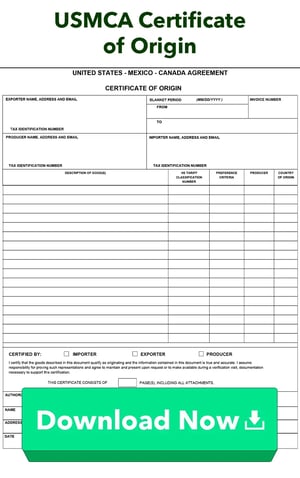 tariffs are imposed outside the agreement’s scope, your products could be impacted regardless of USMCA eligibility.
2. You Can’t Verify Your Products Qualify
Completing and signing the Certification of Origin is more than filling out a document. Don’t take the obligation lightly, and be certain that whomever certifies the document is both knowledgeable of the export and takes responsibility for it.
With increased scrutiny on trade compliance under the shifting tariff landscape, U.S., Canadian, and Mexican customs authorities may become even more stringent in verifying claims. The risk of penalties for inaccurate certifications is higher when trade tensions are elevated.
3. You Can’t Prove Origin
A product that’s made in the United States doesn’t automatically qualify for USMCA. The product must comply with USMCA rules of origin, which distinguish between “origin of goods” versus “originating in a North American country.” (Check out the blog post, Country of Origin Determination: What U.S. Importers Need to Know .)
With trade policy in flux, proving compliance becomes even more critical. If new tariffs target certain sectors or materials, companies may need to reevaluate whether their supply chains still allow their products to qualify under USMCA.

4. Certification Isn’t Worth the Effort
Sometimes, the costs of administering and maintaining a USMCA program and the training it requires make it too expensive and burdensome. Exporters and producers aren’t legally obligated to participate, and for some, the risk of non-compliance outweighs avoiding unnecessary duty payments.
This is especially true if new tariffs offset the benefits of USMCA certification. Exporters should continuously evaluate whether shifting trade policies change the cost-benefit equation of participation.
5. Your Products Simply Don’t Qualify
Finally, some companies choose to opt out for another good reason: their products just don’t qualify under the USMCA. If your goods don't qualify, you shouldn’t participate. Simple as that!
What Does a Valid USMCA Certification Require?
USMCA does not require a specific government form. A certification may appear on an invoice or another document and may be completed and signed electronically.
However, it must include the agreement’s nine minimum data elements:
- Whether the certifier is the importer, exporter or producer.
- Certifier information.
- Exporter information.
- Producer information.
- Importer information, if known.
- A product description and six-digit HS classification.
- The applicable origin criterion.
- The blanket period, if applicable.
- The authorized signature, date and required certification statement.

The certification may cover one shipment or multiple shipments of identical goods over a period of up to 12 months.
If an exporter or producer later learns that a certification contains incorrect information, it must promptly notify everyone to whom the certification was provided. This is another reason to treat certification as a compliance responsibility rather than a routine form request.
How Shipping Solutions Can Help
Navigating USMCA and other free trade agreements can be complex, especially with shifting trade policies. But when your goods do qualify and the tariff savings justify the work, an organized documentation process can make certification much easier.
Shipping Solutions helps exporters determine whether products qualify, store product and shipment information, create accurate certificates of origin and other export documents required for a shipment without repeatedly entering the same data.
Request a free live demo to see how Shipping Solutions can make your export documentation process faster, more consistent and easier to manage.

Like what you read? Subscribe today to the International Trade Blog to get the latest news and tips for exporters and importers delivered to your inbox.
This article was first published in May 2014 under the name When Should You Refuse to Complete the NAFTA Certificate of Origin and has been updated to include current information about the USMCA, new links, and formatting changes.





.webp?width=763&height=852&name=CTA%20-%20How%20to%20Qualify%20for%20a%20Free%20Trade%20Agreement%20(FTA).webp)
