The International Trade Blog  Export Compliance
Who Is the Foreign Principal Party in Interest (FPPI) and Why Are They Important?
On: March 11, 2026 | By:  David Noah |
12 min. read
David Noah |
12 min. read
.webp?width=560&height=315&name=1200%20x%20675%20hubspot%20Who%20Is%20the%20FPPI%20and%20Why%20Are%20They%20Important%20(1).webp) When I talk to exporters about their typical international sales process, I’m often told that they only accept international orders on an Ex Works basis. Or, if they don’t use Incoterms, they tell me they only accept international orders where the foreign buyer agrees to arrange everything once they’ve picked up the goods at the seller’s warehouse.
When I talk to exporters about their typical international sales process, I’m often told that they only accept international orders on an Ex Works basis. Or, if they don’t use Incoterms, they tell me they only accept international orders where the foreign buyer agrees to arrange everything once they’ve picked up the goods at the seller’s warehouse.
From a commercial standpoint, this feels simple:
- You’re the seller.
- They’re the buyer.
- A freight forwarder is handling transportation.
But under the U.S. Foreign Trade Regulations (FTR), those simple business labels aren’t used. They’re replaced by regulatory terms that typically—but not always—mean the same thing. And the official definitions of those regulatory terms determine who controls the shipment, who files the Electronic Export Information (EEI) and who bears compliance responsibility.
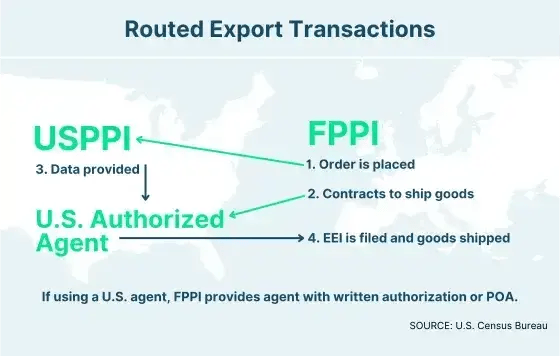
Under the FTR, the foreign buyer is defined as the Foreign Principal Party in Interest (FPPI). When that buyer authorizes a U.S. agent—typically a freight forwarder—to facilitate the export and prepare and file the EEI on their behalf, the transaction becomes what the regulations call a routed export transaction.

Understanding those terms, and what they mean, is essential for small and medium-sized exporters, especially when dealing with routed export transactions.
Let’s clarify it in plain English.
What Is the Foreign Principal Party in Interest (FPPI)?
According to the U.S. Census Bureau, which administers the Foreign Trade Regulations, the FPPI is:
The [...] party shown on the transportation document to whom final delivery or end-use of the goods will be made. This party may be the ultimate consignee. Generally, the FPPI is the foreign buyer of the goods that are purchased or obtained for export.
In practical terms:
The FPPI is usually your foreign customer—the party abroad that purchases or ultimately receives the goods.
However, the FPPI is defined by the regulations, not what your invoice says. That distinction matters when identifying who must file the EEI through the Automated Export System (AES), which is required for most exports valued at more than $2,500 per Schedule B classification, or for any shipment that requires an export license.
FPPI vs. Ultimate Consignee: Are They the Same?
Often—but not always.
The ultimate consignee is the party abroad who ultimately receives the goods.
The FPPI is the foreign party who purchases or obtains the goods for export.
In many transactions, they are the same entity. But not always. For example:
- A foreign distributor may purchase goods (FPPI) and ship them to a separate end user (ultimate consignee).
- A foreign parent company may purchase goods and direct them to a subsidiary.
When it comes to filing the EEI through AES, this distinction is important.
For a more complete explanation of the differences, see our article Export Compliance: Who Is the Ultimate Consignee?, or watch this video:
FPPI vs. USPPI: Why the Distinction Matters
The Foreign Trade Regulations define other parties in the export transaction as well, including the U.S. Principal Party in Interest, or USPPI.
- The FPPI is the foreign party.
- The USPPI is the U.S. party that receives the primary benefit of the export transaction.
In most cases, the USPPI is the U.S. seller. That doesn’t change depending on whether your export is a standard or routed export transaction. But the responsibilities of the two parties do shift depending on the type of transaction, so it’s important to understand who is whom.
(For more details about the responsibilities of the USPPI, see our article on Understanding U.S. Principal Party in Interest.)
When Does the FPPI Matter Most?
The FPPI becomes especially important in a routed export transaction. A routed export transaction occurs when:
The foreign principal party in interest authorizes a U.S. agent—typically a freight forwarder—to facilitate the export and prepare and file the EEI on their behalf.
Notice something important:
Your foreign customer will not say, “This is a routed export transaction.”
Instead, you will see commercial signals:
- The foreign buyer hires the forwarder.
- The buyer instructs you to deliver the goods to their U.S. forwarder.
- The buyer’s forwarder requests your EIN and shipment details.
Whether you intended it or not, those commercial decisions can change your company’s legal responsibilities.
(For a full explanation, see Standard vs. Routed Export Shipment: What U.S. Exporters Need to Know.)

What Are the FPPI’s Responsibilities in a Routed Export Transaction?
Under the FTR, in a routed export transaction, the FPPI is responsible for:
- Controlling the movement of the goods out of the United States
- Selecting and authorizing a U.S. agent (typically a freight forwarder)
- Providing a Power of Attorney (POA) or written authorization allowing that agent to file EEI
However—and this is critical—the FPPI cannot file EEI directly because EEI must be filed by a party residing in the United States.
That means the FPPI must authorize either:
- Their U.S. agent (freight forwarder), or
- The USPPI
to file through AES.
Meanwhile, the USPPI is still responsible for providing accurate export information to the filing party, including:
- Their EIN
- Correct Schedule B or HTS classification
- ECCN (if applicable)
- Value
- License information (if required)
Responsibility for filing may shift but responsibility for accuracy does not disappear.
Why the FPPI Role Is So Important
In one word: compliance.
Many exporters mistakenly assume that when a foreign buyer arranges the freight, they are “off the hook.”
They are not.
Even in a routed export transaction:
- The USPPI remains responsible for providing accurate data.
- The USPPI can still face penalties for false or incomplete information.
- The USPPI’s name appears in the EEI filing.
In fact, the U.S. Census Bureau has repeatedly emphasized that misunderstanding routed transactions is a common source of compliance errors.
This is why many compliance professionals recommend that the USPPI request the authority to file EEI themselves, even in routed transactions, to maintain visibility and control.
2025 Updates to the Foreign Trade Regulations
In 2025, updates to the Foreign Trade Regulations clarified several definitions and reinforced filing responsibilities under routed export transactions.
Shipping Solutions hosted a one-hour webinar with Census Bureau staff outlining these changes and answering exporter questions. We also published a detailed summary of the 2025 FTR changes and provide access to the webinar recording.
The Census Bureau speaker pointed out two important updates to the regulations:
First, while Census has long said that the regulations don’t connect specific Incoterms 2020 Rules to the definition of a routed export transaction, that is now expressly stated in the FTR. It is not the term EXW that identifies a routed export transaction. It is the buyer’s responsibilities under that term that make the definition apply.
Second, a newly published Appendix C in the FTR explicitly lists which EEI data elements must be provided by the USPPI and the FPPI’s Authorized Agent in a routed export. This listing can help avoid confusion when the two parties are different.
Exporters who rely on Incoterms alone to determine filing responsibility should review these updates carefully.

Common Compliance Risks Involving the FPPI
Here are some real-world risk scenarios I’ve seen among small and medium-sized exporters:
- Assuming the forwarder “handles everything” without confirming who is filing and under what authority.
- Failing to obtain written authorization documentation, especially when filing on behalf of the FPPI.
- Providing incomplete or inaccurate export information, believing responsibility shifted entirely to the buyer.
- Not retaining documentation in the event of a government audit.
The key principle is this:
- Commercial terms determine who pays for freight.
- Regulatory definitions determine who carries compliance responsibility.
Best Practice: Maintain Visibility
Even when the FPPI controls transportation, many experienced exporters choose to:
- Request filing authority
- File EEI themselves
- Maintain documentation control
This approach reduces compliance risk and ensures accuracy.
Shipping Solutions export documentation software simplifies this process by allowing you to file through AES while simultaneously producing required export forms and maintaining a clear compliance record.
If you would like to see how it works, sign up for a free online demo. There's no obligation.
Final Thoughts
The term “Foreign Principal Party in Interest” may not appear on your invoice. Your customer may never use the phrase.
But under the U.S. Foreign Trade Regulations, that definition determines who controls the shipment, who authorizes the filing and how compliance responsibility is assigned.
Understanding the FPPI is not about memorizing acronyms. It is about translating business practice into regulatory language and protecting your company from avoidable compliance risk.

Like what you read? Subscribe today to the International Trade Blog to get the latest news and tips for exporters and importers delivered to your inbox.
This article was first published in February 2015 and has been updated to include current information, links and formatting.